Rain fell on Petrograd. A cold, steady December drizzle that turned the granite embankments of the Griboyedov Canal to slick black glass. The water below was the color of lead, disturbed only by the relentless pinpricks of the downpour. Sineus stood without an umbrella. He felt the cold seep into the shoulders of his wool coat. He did not mind. The cold was a fact. The rain was a fact. They were clean, honest things.
He stood on the same stretch of canal where he and Anja had met Count Orlov. A lifetime ago. He could feel the memory of the place, a faint, greasy residue of ambition and deceit. He did not try to erase it. He simply noted it, another scar on the city’s skin. The air smelled of wet stone and winter.
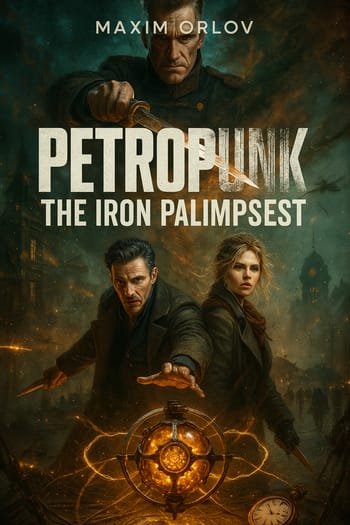
In his hand, he held his father’s silver pocket watch. It was cool and heavy. He did not polish it anymore. The crystal face was not just cracked; it was shattered. A spiderweb of fractures radiated from the center, the hands frozen at the exact moment Dr. Morozov had been executed. The moment Lilya had died. He ran his thumb over the broken glass. The sharp edges were a comfort. A truth.
The man he used to be would have been consumed by the imperfection. He would have seen it as a failure of order, a flaw to be corrected. He would have taken it back to his workshop, disassembled it, tried to purge the memory of its breaking. He would have tried to make it a clean, sterile object again. A thing without a past. He felt no such impulse now. The watch was broken. That was its story. That was its truth. To fix it would be a lie.
He simply held it. The weight was a reminder. The brokenness was a monument.
A figure detached itself from the grey gloom of the far side of the street. A boy, no older than twelve, wrapped in a coat that was too big for him. He moved with the quick, furtive energy of the city’s messengers, his eyes scanning everything. He crossed the empty street, his worn boots splashing in the puddles. He stopped a few meters from Sineus, wary.
— Are you him? — the boy asked. His voice was thin, but it held the hard edge of the streets.
Sineus did not answer. He just watched.
The boy seemed to take his silence as confirmation. He held out a small, heavy package wrapped in oilcloth and tied with rough twine. — This is for you.
Sineus took the package. It was heavier than it looked. He had no money on him. He had nothing to give the boy. He looked at the courier, who was already backing away, ready to melt back into the city.
— Wait, — Sineus said.
The boy paused.
Sineus reached into his coat pocket and pulled out a military surplus nutrient bar. A hard, tasteless brick of calories he had taken from the catacombs. He held it out. The boy’s eyes widened for a fraction of a second. He darted forward, snatched the bar, and was gone. A ghost in the rain.
Sineus looked down at the package in his hand. He unwrapped the oilcloth. Inside, nestled in a bed of wood shavings, was a single object. A clockwork gear. It was small, no bigger than his thumb, but it was a masterpiece of machining. The metal was a dark, unfamiliar alloy, its teeth cut with a precision that spoke of a master’s hand. It was perfect. Flawless.
He knew what it was. Anja’s calling card.
She was alive.
The thought did not bring the simple relief he might have expected. It was a complex thing. A flicker of warmth, quickly extinguished by a cold wave of consequence. She had used the Syndicate’s Failsafe. The forbidden tech that had saved her once before. It meant she had survived. It also meant her debt to the Black Sea Combine was now absolute. A leash pulled tight around her throat. She had paid for his life with her freedom. A debt is a debt.
He closed his hand around the gear. The metal was cold, its edges sharp and definite. It was a promise and a threat. A loose thread in a world he had tried to make neat. He slipped it into his pocket. Another weight to carry.
He felt the locket at his throat. It was warm against his skin, a steady, living heat that defied the cold day. The warmth was a constant reminder of the ritual in the power station. The artisan’s life, his own grief, and the locket’s strange resonance, all fused in a moment of impossible physics. The map inside his head was no longer a frantic whisper. It was a quiet, constant hum. A direction. A purpose he had not asked for but could not ignore.
The Heart of the Artisan was a dead stone. The artisan’s memory was a quiet guest in his mind. The Ticker’s Rattle was gone, its maddening rhythm replaced by the simple, steady beat of his own heart. He had won. The Iron Palimpsest was saved. The Whispering Plague had receded.
But he was alone. Lilya was a memory. Morozov was a ghost. Anja was a debt.
He looked at the grey water of the canal. He saw his reflection. A man standing in the rain. A man haunted not by the past, but by the future. He had spent his life trying to erase history, to create a world of sterile, unburdened things. A world of perfect, silent machines.
He closed his fist in his pocket, his knuckles pressing against the cold, perfect teeth of the gear.
He was no longer a man who erases the past. He was the man who carries it.
The rain fell harder, washing the city clean. A distant boat horn echoed across the water.