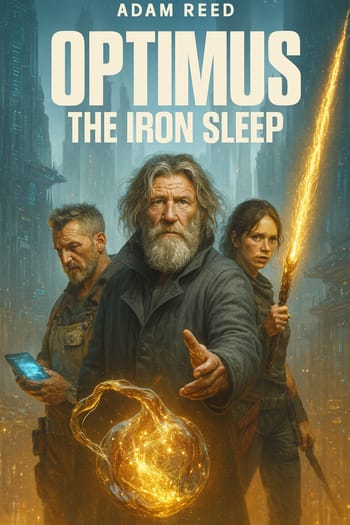
The trainees were gone. The only evidence of their panicked flight was an overturned cot and the lingering, sharp smell of scorched ozone. Elias Thorne sat on a metal stool in the center of the training space, a cleared-out section of the Foundry Chorus where the ghosts of old machinery slept in the dim amber light. His head throbbed with a low, persistent ache, the psychic hangover from the feedback loop that had nearly torn two of his students apart. The bank of biomonitors against the far wall was dark, a row of dead eyes that had erupted in a shower of green sparks only an hour ago.
He was alone with Lena Petrova. She stood by the entrance, arms crossed, a silhouette against the vast, humming darkness of the Foundry. For seven minutes, neither of them spoke. The silence was a physical thing, a space filled with the drip of water from a high, rusted pipe and the wreckage of his philosophy. He had taught them to build shields of calm thought. She had taught them to forge spears from pure pain. And when the two had met, they had almost created a grave. He had failed to protect them. His entire purpose, the one he had built from the ashes of his old life as an optimizer for the Mandate, felt like another system hitting a critical error.
He thought of the Weaver's Thread, a constant, physical reminder of a different failure, a different loss. He had taught them to weave reality from threads of imagination. He had never considered what would happen when someone wove a blade.
Lena finally moved, her boots loud on the concrete floor. She walked past the dead biomonitors, her gaze sweeping over the evidence of their near-disaster. She stopped a few feet from him, not looking at him, but at the space where the two opposing psychic forces had collided.
"It almost killed them," she said. Her voice was flat, an assessment, not an apology.
Elias did not answer. He just stared at the floor, tracing the patterns of rust and grime.
— And it worked, — Lena added, the words quiet but sharp as broken glass.
He finally looked up at her. Her face, usually a mask of impatient fury, was different. It was stripped bare, showing a mixture of shock and something he could not name. It was not triumph. It was discovery. She was a strategist before she was a zealot, and she had just seen a new variable enter the equation.
— It was uncontrolled, — Elias said, his voice raspy. — It was chaos. We were lucky.
— Luck is a variable you can’t plan for, — she countered, turning to face him fully. — Your shields are too slow. My spears are too unstable. We saw that. But for a second, when they hit each other… the energy didn’t just scatter. It focused.
She was right. He had felt it. The chaotic, outward blast of the emotional spear had been contained and directed by the rigid, inward pressure of the defensive shield. It was an obscene synergy, a fusion of two things that should have annihilated each other. It was a new language, and they had stumbled upon it by accident.
— My methods are insufficient, — Elias admitted. The words tasted like defeat. He had built his entire rebellion, his entire second chance at a meaningful life, on the principle of healing, of reclaiming the soul, not weaponizing it. He had offered them shelter, and she had proven they needed a sword. The price of this admission was his pride, the certainty of the teacher, the quiet authority of the man with all the answers. He had no answers.
— So are mine, — Lena said, and the concession seemed to cost her just as much. — Raw grief is a fire. It burns the person holding it as much as the target. I can teach them to make the fire, but I can’t teach them how to hold it without getting burned.
There it was. The truth, laid bare in the quiet, broken room. He had the vessel. She had the fire. Separately, they were a liability. A prayer that was too slow, a bomb that was too volatile.
He thought of his old life, of optimizing systems, of finding elegant solutions to complex problems. He had run from that man, the cold, detached analyst who saw people as data points. But the ghost of that man was still inside him, and it saw the shape of the solution. It was a terrible, elegant solution.
— We need to co-design it, — Elias said, the words feeling foreign in his mouth. He stood up, the movement stiff. His head still ached. — We need to build it intentionally.
Lena’s eyes narrowed. — Build what?
— The weapon, — Elias said. — The Sheathed Spear.
He walked over to a functional terminal against the wall, its screen dark. He powered it on, and the amber light cast their tired faces in a warm glow. He picked up a stylus. For a moment, he just looked at the blank screen, the empty canvas. He was about to draw a blueprint for a weapon made of souls. It felt like a betrayal of everything he stood for. It also felt like the only path forward.
— Show me, — he said, turning to her. — Show me what it feels like. Not the memory. The shape of the energy.
Lena came and stood beside him, her presence a tense, coiled spring. She did not touch the stylus. She used her hands, her fingers hovering over the screen as if she could physically mold the light.
— It’s not a wave, — she began, her voice losing its hard edge, becoming focused, analytical. — It’s a line. A vector. It starts here, — she tapped a point on the screen, — with the core grief. It’s dense. Heavy. It wants to explode outward, in all directions.
As she spoke, Elias began to draw. He sketched a tight, dark point, then a series of arrows radiating out from it, a diagram of a psychic explosion.
— That’s the problem, — he murmured. — It’s inefficient. The energy dissipates.
— Yes, — she said, a flicker of surprise in her eyes that he understood. — So I teach them to focus it. To push all that outward pressure into a single point. To make it a needle.
Elias erased the radiating arrows. He drew a single, long, sharp line extending from the core. The image on the screen looked like a black icicle. Unstable. Brittle.
— That’s what happened to the recruit, — he said. — The needle is too pure. It has no structural integrity. It shatters on impact with anything solid. Or it shatters the mind holding it.
— So we give it a sheath, — Lena said, her voice low. She was following his logic, meeting him halfway.
Elias’s stylus moved again. Around the dark needle, he began to weave a series of concentric, flowing lines, a pattern he had drawn a thousand times when teaching his students to build their shields. It was the Weaver’s Thread, his symbol of creation, of gentle, ordered reality. But here, it was not the whole picture. It was a container.
— Not a wall, — he said, thinking aloud. — A vessel. It has to be flexible. It needs to absorb the outward pressure of the core without breaking. It contains the explosion and channels it.
— It’s a gun barrel, — Lena said, her metaphor brutally simple and effective. — The grief is the gunpowder. The intent is the bullet. Your shield is the barrel.
He stopped drawing. He looked at the diagram on the screen. A dark, sharp core of violent energy, perfectly contained within a woven sheath of calm, structured thought. The two waveforms he sketched below it, once chaotic and opposing, now merged into a single, unified, pulsing sine wave. It was horrifying. And it was perfect.
He felt a strange sense of vertigo, a feeling of standing on a bridge between two worlds. The world of the healer and the world of the warrior. He had spent years believing they were separate continents. Now he saw they were just two sides of the same hand. This was the new language. A terrible, necessary poetry written in force and control.
The silence returned, but it was different now. It was not the silence of a standoff, but of shared, focused work. The air no longer smelled only of ozone, but of something new being forged.
The quiet was broken by the sound of footsteps.
Corbin Shaw, the rebellion’s data analyst, stood at the entrance. His face was, as always, a mask of neutral observation. He held a datapad. He saw the diagram on the screen, his eyes flickered over it for a fraction of a second, processing, categorizing, and then he dismissed it. It was not his department.
— I have a location, — Corbin said, his voice a flat monotone that cut through the fragile synergy in the room. — Relay Station Epsilon-9. It’s a defunct Dreamscape relay. Been offline for seven years. Completely isolated.
He looked at Lena, then at Elias. He was not asking for their approval. He was stating a fact. He had been given a task, and he had completed it.
— It’s the perfect hunting ground.
The words hung in the air, cold and hard. The theoretical diagram on the screen suddenly felt very real. It was no longer a concept. It was a tool for a job.
The hum of the Foundry seemed to grow louder, a clock ticking. The distant drip of water sounded like a countdown.
Now they had to build the weapon.