He had run. That was the simple, mechanical truth of it. He had run from the Foundry Chorus, from the panicked faces and the smell of burnt electronics, from the weight of forty minds he had led into a slaughterhouse of memory. Now he sat in the absolute darkness of an abandoned transit tunnel, a place where the city’s constant hum was just a low vibration in the stone. The only sound was the slow, rhythmic drip of water, each drop hitting a puddle with a fat, echoing plink. It was a clock measuring nothing. He was alone.
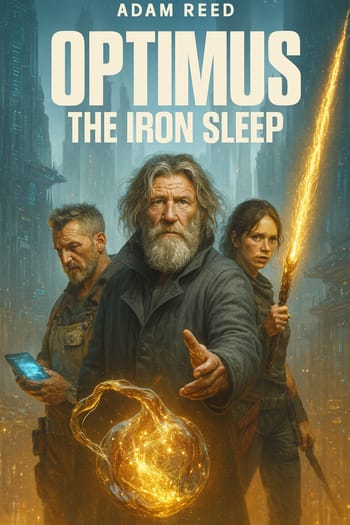
In his hand, he held the artifact. The fragment of the Weaver’s Thread, torn from the dream of the Boiler Room by the force of its own destruction, was still warm. It was a physical piece of his failure, a receipt for a price he had not known he was paying. The light it had held in the dream was gone, leaving only a tangible warmth against his cold skin. It was the heat of a fever. It was the heat of a scar. He had taught them to weave threads of hope, and the Architect had used those same threads to hang them. The symbol of their philosophy was now just a scrap of impossible matter in his palm, a reminder of everything he had lost for them.
He considered his options with the cold, detached precision of the man he used to be. Surrender was one. Walk to the surface, find a Warden, and let the machine have him. It would be an admission of defeat, a final validation of the Architect’s worldview. Disappearance was another. He could lose himself in the undercity’s forgotten warrens, become another ghost in the system. A coward’s peace. Then there was the third option, the one that whispered with the clean, simple logic of a closed circuit. The final optimization. He felt the appeal of the Mandate’s empty peace, the quiet of a mind that no longer had to feel the weight of its own choices. The despair was a physical pressure, a certainty that felt like 95% of the air being replaced by lead.
He closed his eyes, but the darkness behind them was worse. It was filled with the image of Silas Kane, his oldest friend, standing in the dream-replica of their first home. The eyes were wrong. The movements were wrong. He watched again as Silas’s puppet hands took their first creation, the patchwork blanket of their shared hope, and pulled. The memory was a psychic wound, a loop of code that would not stop running. The Architect had not just killed them; he had made them watch their own history commit suicide. He had turned their love into the murder weapon.
The feeling was horribly familiar. The cold concrete beneath him felt like the floor of a sterile hotel room. The recycled air smelled the same. He was back there, years ago, after his first life had collapsed under the weight of its own efficiency. He had optimized everything—his work, his marriage, his soul—until nothing was left but the hum of the machine. He had thought this rebellion, this teaching, was his second chance. A way to prove that the human heart could not be quantified. He had been wrong. He had simply found a new system to break. His identity as a teacher, a healer, a protector—it all flaked away like rust, revealing the same hollowed-out automaton underneath.
He had failed at being a machine, and now he had failed at being a man.
The thoughts stopped. The cycling scenarios of failure ceased their frantic spin. There was only the tunnel. The cold. The damp smell of stone and decay. He did not move. He did not think. He was an object in a space, a point of mass in the darkness, governed by inertia. He had reached the absolute bottom, a place so deep and quiet that even hope could not draw a breath. He just sat. He breathed in the cold air. He breathed out.
The slow, steady drip of water measured the silence. A faint scent of ozone and wet metal hung in the air.
From the far end of the tunnel, a shadow detached itself from the deeper darkness and began to walk.