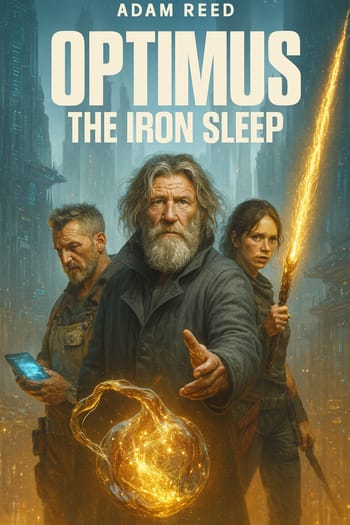
The quiet was a new kind of heavy. It was not the silence of hiding, but the silence after a great machine has been broken. In the vast, cold dark of the Foundry Chorus, Elias Thorne sat at a scavenged metal table. The air smelled of ozone and hot, tired metal. Across from him, Silas Kane, his oldest friend, stared at a wall, his eyes focused on something a thousand miles away. Lena Petrova stood with her back to them, a sharp silhouette against the amber glow of a single active terminal.
On the table between the two men, a small, frayed length of woven light lay coiled. It was the Weaver's Thread, or what was left of it. A piece of a dream that had survived a real explosion. It was perpetually warm to the touch. A scar made tangible.
Silas spoke, his voice a monotone, a perfect echo of a voice they had all hoped to never hear again.
— The probability of a coordinated counter-assault within the next 72 hours is 87.4 percent, assuming they can re-establish command hierarchy. —
He blinked. The cold, clean logic receded from his eyes, replaced by a familiar, weary confusion. He looked at his own hands on the table as if they belonged to a stranger.
— Sorry, — Silas murmured, his voice returning to its normal, low rumble. — It… echoes. The math is loud. —
Elias nodded. He understood. He understood better than anyone.
Lena turned from her terminal. The victory had not softened her. It had sharpened her. The fatigue on her face was the fatigue of a general after a battle, not a dreamer after a session.
— Let it echo, — she said, her voice crisp. — We control the Canal Grid. Their primary logistics are severed. The Spire is dark. For now, they’re blind. —
She gestured to the screen, which showed a simplified map of Circadia’s underbelly. Dozens of key junctions, once red, were now a steady, defiant green. They had taken the city’s veins. This was the new reality. The hidden resistance had become an open war, with fronts and supply lines. The value of their fight was no longer measured in reclaimed souls, but in captured territory.
— Their forces are in disarray, but they’re regrouping in the outer sectors, — Lena continued, her report clean and stripped of emotion. — They’re falling back to pre-designated rally points. They’re clumsy. Predictable. —
She was right. They were predictable. Elias felt a pulse behind his own eyes, a familiar, cold, clean ache. The Architect’s scar. For a single, terrible microsecond, he saw the variables Lena was ignoring. He saw the 12.6 percent chance she was dismissing. He saw the branching paths of probability that led to their total annihilation, each one calculated with the cold, perfect logic of the machine he had killed.
That was the price of his choice in the server fortress. To save his friend, he had let a piece of the enemy into his own head. He had weaponized empathy, and the blade had left a splinter of itself in his soul. He took a slow breath, pushing the cold math down. It was a fight he would have to have with himself for the rest of his life. He could not let the machine he defeated build a new home in his own mind.
He looked at Silas, who was tracing the rim of a tin cup of nutrient broth, his movements slow and deliberate. The man was free, but not whole. He was a walking monument to the cost of their victory. Every time Silas spoke with the ghost of the Architect’s logic, it was a reminder that you could not fight a system like the Mandate without getting some of its filth on you.
Elias reached out and laid his hand flat on the table, his fingers inches from the Weaver's Thread. The artifact was not a symbol of his gentle philosophy anymore. It was not a relic of a failed idea. It was proof. It was a piece of a dream, forged in hope, corrupted into a weapon, and then physically born from an act of war. It was a testament to their entire, messy, brutal, and necessary journey from automated efficiency to this, to authentic, scarred humanity.
Lena’s report was finished. She looked at Elias, her expression waiting. She was a commander, but he was still the Coach. They were a new thing, a spear and a shield fused into one. The whole Foundry, with its sleeping giants of old machinery and its exhausted, hopeful people, was waiting for him to speak.
— You’re right, — Elias said, his voice quiet but carrying through the cavernous space. — They’re blind. But not for long. —
He looked from Lena’s sharp, ready face to Silas’s distant, wounded eyes. He saw the two halves of their rebellion. The fire and the cost. The future and the past. He was the bridge between them now. That was his new work.
— Get some rest, — he said. It was an order, but his voice was gentle. A general who still remembered how to be a healer. — Both of you. The war didn’t end. It just began. —
Lena gave a sharp, tired nod and walked away, disappearing into the shadows of the Foundry. Silas looked at Elias, a flicker of the old, true friendship in his eyes, a silent acknowledgment of the chasm they had both crossed. Then he stood and walked slowly toward the small alcove that served as his quarters.
Elias was alone at the table. The great, silent space of the Foundry Chorus smelled of old iron and the faint, clean scent of ozone. The dim amber work-lights cast long, dancing shadows from the monolithic, silent machinery.
He picked up the Weaver’s Thread. It was solid. It was real.
His new purpose was clear. They would start mapping the fallbacks at dawn.