The service corridor was a concession to function in a world built on form. Here, beneath the pristine, seamless surfaces of Aethelburg, the capital’s true anatomy was exposed. Massive conduits, cool to the touch and coated in a thin film of condensation, ran along the walls like the arteries of a sleeping giant. The air, unlike the scrubbed vacuum of the public levels, smelled of ozone and the sharp, clean scent of super-cooled machinery. Their footsteps echoed, a small, irregular rhythm against the constant, low-frequency hum of a planet’s worth of power. Corian felt the psychic restraints around his temples not as a pressure, but as a void. The background hum of the Logos, the collective consciousness that was as natural to him as breathing, was gone. It was a profound and unnerving blindness, forcing him to rely on the two people who walked with him.
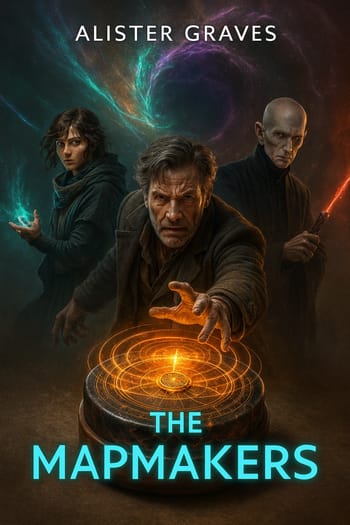
Ahead, Lucian Crell moved with the chilling confidence of a man returned to his native element. The severe black robes of a Censor Primus seemed to draw in the corridor’s dim light, making him a figure of pure, negative space. Beside Corian, Elara clutched the heavy case containing the Codex Paradoxa, her knuckles white. Her own disguise, the stiff grey robes of an acolyte, seemed to fight against her, a cage of fabric holding back a storm. They were a trio of ghosts, a lie given form, moving through the machine’s hidden passages.
A heavy bulkhead slid shut, blocking their path. The sound was a solid, definitive thud. For a heartbeat, Corian thought the deception was over. Then, the bulkhead slid open again, revealing not an empty corridor, but a wall of silent, imposing figures.
Five of them, clad in the stark white armor of the First Consul’s elite guard. The armor was seamless, its polished surfaces reflecting the corridor’s utility lights in distorted, elongated lines. They held no weapons. Their weapons were integrated into their gauntlets, a subtle thickening of the alloy over the knuckles and forearms. At their center stood Admiral Hectorian Varro, the master tactician whose fleet had nearly crushed them in the Belief Nebula. His face was as severe and geometric as his battle formations, and his stony grey eyes were fixed on Crell.
— Censor, — Varro’s voice was a low, steady baritone, the sound of gravel settling. — The First Consul’s orders are to stop you. Your authority is suspended pending inquiry.
Crell did not flinch. He took a single step forward, positioning himself between Varro and the rest of them. Corian remained in his role as the broken prisoner, shoulders slumped, eyes downcast, but his mind was racing, analyzing the confrontation. This was a clash not of weapons, but of two different kinds of Order. Crell’s was the Order of pure doctrine, absolute and philosophical. Varro’s was the Order of mathematics, of clean lines and verifiable data.
— Admiral, — Crell’s reply was as flat and emotionless as ever. — I am acting on a direct mandate to preserve the integrity of the Canon. This prisoner is key to that preservation.
— My orders are from the First Consul himself, — Varro stated, his voice unwavering. He was a man who understood and respected the chain of command. It was the architecture of his entire existence. — He has declared this operation rogue. You will stand down.
Crell was silent for a moment. Corian watched the subtle shift in the Censor’s posture. He was changing tactics. He was abandoning the appeal to authority and moving to the only language Varro truly respected.
— And your field telemetry, Admiral? — Crell asked. — Does it align with the First Consul’s orders?
The question hung in the air, sharp and precise as a scalpel. It was a direct challenge to the core of Varro’s being. The Admiral’s jaw tightened. The perfect, disciplined mask of the fleet officer showed its first crack. He had built his life on the principle that data did not lie. Politics, belief, even the Canon itself—these were interpretations. But the numbers were pure.
Varro did not answer immediately. Instead, he raised a datapad from his belt. With a flick of his thumb, he activated its display and turned it for Crell to see. Corian, feigning weakness, shifted his position just enough to catch a glimpse of the screen. It showed a map of the outer sectors, overlaid with a sickly, spreading stain of violet and green. It was the Conceptual Bleed. A line of text at the bottom of the display showed its rate of expansion: accelerating at seven percent beyond all initial projections. Varro knew. He had seen the truth of the crisis, the real threat that was eroding entire sectors while the fleet hunted a single man.
— The First Consul’s strategy is politically expedient, — Varro said, his voice low, almost a confession. — But it is strategically unsound. The Bleed is the primary threat.
— Then you understand, — Crell pressed, his voice still a monotone, but now it carried the weight of shared, terrible knowledge. — The First Consul’s orders will not contain the Bleed. They will create a static, dead universe, a final, perfect order of silence and dust. We are not running from the consequences of heresy. We are running towards the only viable solution.
The corridor was silent save for the hum of the conduits. The five elite guards remained motionless, perfect statues of obedience, their helmeted heads tracking the exchange. They were waiting for their commander’s decision. Corian watched Varro’s face. He saw the war happening behind the man’s eyes. It was the battle of his entire life, the rigid lines of duty warring against the elegant, brutal curves of his own logic. He was a man caught between his map and the new world it failed to describe.
Corian thought of the Cracked Compass, lying abandoned on the floor of the Vagrant. He pictured its needle swinging wildly between the circle of Order and the scribble of Chaos. Varro was that needle, trembling at the center, forced to choose.
The Admiral’s gaze shifted from Crell to Corian, then to Elara. He saw a broken heretic and a terrified acolyte. He saw the lie they were performing. But his eyes, the eyes of a master strategist, looked deeper. He saw the shape of their desperation, the impossible geometry of their plan. He saw a single, improbable variable in an equation that otherwise led to absolute ruin.
Slowly, deliberately, Hectorian Varro lowered his arm. The integrated weapon in his gauntlet powered down with a faint, almost inaudible sigh of discharged energy. He had made his choice. The price of it was etched on his face. Corian saw in the Admiral’s expression the look of a man who had just sacrificed his entire history, his honor, his place in the structure he had sworn to defend, all for a single, desperate calculation.
— Bring me back something worth defending, — Varro said. The words were not an order. They were a plea.
He turned to his elite guard. — Stand down.
The five armored figures did not question the command. They lowered their arms in perfect, silent unison, their integrated weapons retracting. They became statues again, guardians of a corridor they were now ordered to leave open.
Varro tapped his comms unit. His voice, when he spoke, was once again the clipped, professional tone of a fleet officer. — Command, this is Varro. We have a confirmed sighting of the fugitives in Sector Gamma-7. They are moving towards the outer system. I am redeploying my unit to intercept.
It was a clean, precise lie. A piece of weaponized data sent into the Mandate’s own network. He was giving them time, purchased with the currency of his career.
— Go, — Varro said, his back now to them, his attention fixed on the false telemetry he was creating. He did not want to watch them leave. He did not want to witness the finality of his own treason.
Crell gave a single, sharp nod. He turned and began to walk, his pace quick and purposeful. Elara followed, her grip on the Codex case so tight her knuckles were bloodless. Corian moved with them, the feigned weakness falling away, replaced by the urgency of their new, impossible alliance. They walked past the silent, armored guards, past the man who had just broken his world to give them a path through his.
The corridor ahead was long and straight. At its end, the air itself seemed to shimmer, and the low hum of the ship’s systems was being slowly drowned out by a new sound. It was a deeper, more fundamental vibration, a resonance that Corian felt in his bones even through the psychic silence of the restraints. It was the sound of the universe’s engine, waiting.
The air grew warmer, carrying a scent like ozone after a thunderstorm. The white alloy of the walls gave way to a darker, more ancient material that seemed to absorb the light.
Ahead, the path to the heart of the Logos was now open.