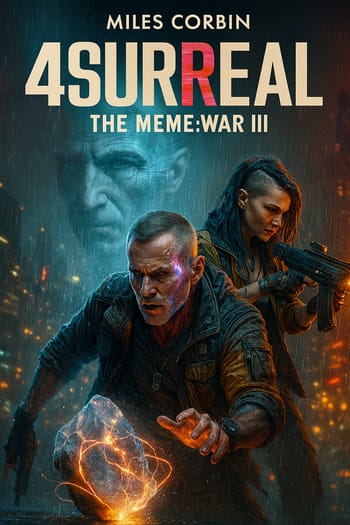
The first sound was a trio of soft, synchronized coughs from three directions at once. Breaching charges, not loud, just firm enough to pop the warehouse’s loading bay doors from their frames. Croft and Sabine were already moving, diving behind a towering pallet of expired protein supplements as the first rounds of suppressor fire began to thud into the cardboard crates. The impacts were quiet, like a relentless, heavy finger pressing into the dusty packaging, each one a potential death.
Ten figures in non-reflective black tactical gear flowed into the dim space, their movements fluid and economical. They were not the grey-clad, lumbering agents of the Cognitive Immunology Division. These were corporate soldiers, a Panacea Protocols kill-team, and they moved with the brutal efficiency of a market correction. Muzzle flashes from their rifles were tight, strobing blue wasps in the gloom. They were boxing Croft and Sabine in, cutting off the path back to the terminal and their van.
— They’re flanking! — Sabine’s voice was a low rasp next to his ear, the smell of ozone and hot dust sharp in his nostrils. — I need that logistics terminal. Now.
— You’ve got ten seconds! — Croft snapped, firing his own sidearm over the top of the crates. The loud bark of the conventional firearm was a vulgar shout in the quiet conversation of the suppressors. It was a desperate, clumsy noise.
Sabine was already gone, a blur of motion as she sprinted across a twenty-meter gap of open concrete to a grimy maintenance terminal. Croft laid down covering fire, the recoil a familiar anchor in the chaos. He saw a round spark off the wall just behind her head. The price of her hack was his exposure. He ducked back down as a volley of rounds shredded the crate he was using for cover, showering him in a fine, sweet-smelling powder of vanilla-flavored failure.
— Enjoy the robot uprising, assholes, — Sabine muttered, her voice a tinny ghost from his comms. A row of emergency lights flickered overhead. A deep, groaning hum vibrated through the concrete floor.
The nearest forklift, a hulking yellow machine that had been dormant for years, jerked to life. Its forks lifted and lowered erratically, its backup alarm beginning a demented, off-key beeping. Then another forklift started, and another. Sabine hadn’t just hacked them; she’d given them a seizure. The machines began to move, not with purpose, but with a chaotic, destructive randomness, lurching towards the kill-team’s position. The corporate soldiers were forced to break formation, their tight fire discipline dissolving as they dodged the rogue machines.
It created a window. A small one.
A soldier, momentarily clear of the mechanical chaos, raised his rifle, sighting directly on Sabine’s exposed back. There was no time for a warning. There was no time for thought. There was only the immediate, physical threat. The cold, analytical fury of the Equity-Aggressor parasite vanished, replaced by a hot, simple rage. The Patriot-Primal surged, flooding Croft’s system with adrenaline. The world compressed to a single imperative: break things.
He didn’t think. He acted. He slammed his shoulder into the towering metal shelving unit beside him, a twenty-foot wall of expired dreams. The structure groaned, protesting the sudden violence. He pushed again, his muscles screaming, the parasite overriding all sense of self-preservation. With a shriek of tortured metal, the entire unit began to topple. It fell like a dying giant, crashing down in a slow-motion avalanche of cardboard, plastic, and dust.
The crash was deafening, a roar of destruction that momentarily drowned out all other sound. It created a solid barrier of wreckage, blocking the kill-team’s advance from the west. A thick cloud of dust billowed out, reducing visibility to near zero. They had a new path, but the old one was gone forever.
The hot rage in his blood cooled, replaced by a different kind of energy. The immediate physical threat was gone, replaced by a complex tactical problem: a chaotic, moving landscape of machinery between them and the far side of the warehouse. The Patriot-Primal receded, its job done. The Equity-Aggressor, the strategist, the pattern-seeker, slid back into place. It didn't offer an opinion on the situation; it simply analyzed the patterns in the madness Sabine had unleashed. It saw the rhythm of the conveyor belts, the swing of the robotic arms, the gaps in the dance.
A path appeared in his mind, a clean, logical line through the chaos. It was a fleeting, distorted echo of the perfect schematics he could build in the REM Diagram, a moment of clarity born from the heart of the conflict. He was not in control, but he was learning to switch between the pilots.
— This way! — he yelled, grabbing Sabine’s arm.
She didn’t question him. She ran. They plunged into the heart of the automated chaos. A robotic arm swung a crate of ‘Sereni-Tea’ over their heads. They ducked under it. A conveyor belt moving at high speed blocked their path. Croft vaulted over it, then pulled Sabine across. His movements were a strange fusion of the two parasites: the brute force of the Patriot-Primal clearing obstacles, the cold, analytical grace of the Equity-Aggressor choosing the path. They were a walking system failure, and it was the only thing keeping them alive.
They moved through the mechanical guts of the warehouse, a blur of coordinated motion. They successfully evaded the remaining soldiers, who were still trying to navigate the forklift rebellion. They were a single, two-person organism, their trust absolute and unspoken. They finally burst through the chaos into the relative quiet of the disposal sector on the far side of the building.
The air here was different. It was thick with the cloying, sickly-sweet smell of decay. This was where products went to die.
— There, — Sabine pointed, her breath coming in ragged gasps.
At the end of a dark corridor was a large, square opening in the floor. A corpse chute, designed for dumping pallets of expired, semi-organic nutrient paste into the city’s reclamation system. It was a disgusting, desperate, and perfect escape route.
The sound of boots on concrete echoed from the corridor behind them. The kill-team had broken through.
— Go! — Croft yelled.
There was no time for hesitation. They took a running start and dove headfirst into the chute. For a moment, they were airborne in the darkness, the sounds of the warehouse vanishing above them. They had the sample of ‘Clarity,’ but everything else—their vehicle, their gear, their last connection to a world of resources—was gone. The price of escape was to become ghosts.
They hit the bottom of the chute, landing in a slurry of cold, viscous liquid and soft, yielding solids. The impact was a shock, but they were alive. They had escaped.
The darkness was absolute, the silence broken only by their own ragged breathing. The air tasted of rot and chemical preservatives.
The warehouse was behind them, but the hunt had just begun.