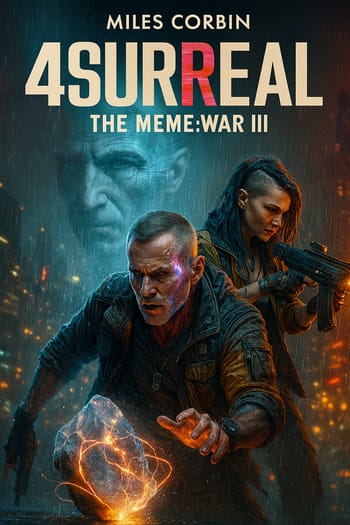
The stench hit him first, a chemical cocktail of decay and cloying artificial sweeteners. It clung to their clothes, a foul baptism from the corpse chute. Croft pushed himself up from the slick concrete of the alley, his muscles screaming in protest. The slurry from the chute dripped from his hair, cold and viscous. Beside him, Sabine Weil was already on her feet, her lean frame coiled with a tense energy that ignored the filth. They had escaped, but the price was everything. Their vehicle, their gear, their anonymity—all gone, left behind in the chaotic symphony of Sabine’s forklift rebellion.
They were ghosts now, on foot in the dripping guts of the Symbiote Sectors with nothing but a single, priceless bottle of Panacea Protocols’ ‘Clarity’ and the clothes on their backs. Every shadow seemed to hold the silhouette of a corporate soldier. Every flicker of a distant neon sign felt like the sweep of a targeting laser. His parasites, the Equity-Aggressor and the Patriot-Primal, were strangely quiet, stunned into submission by the raw, physical shock of the escape. In their place was a different kind of noise: the cold, sharp hum of pure animal fear.
— This way, — Sabine rasped, her voice barely a whisper. She grabbed his arm, her grip surprisingly strong, and pulled him into the flow of the sector’s grimy pedestrian traffic.
She led him through a maze of narrow corridors, the air thick with the competing smells of cheap synth-noodles, ozone, and the damp, biological scent of overlapping memetic graffiti. The walls were a palimpsest of forgotten crusades, new slogans stenciled hastily over faded declarations of ideological war. They passed a noodle bar, its windows fogged with steam, the low thrum of a dozen conversations spilling out into the alley. It was a pocket of mundane life in the middle of their high-stakes flight. It was perfect.
— In here, — she said, pushing through the beaded curtain that served as a door.
The inside was a sensory assault. The air was a wall of steam, salt, and chili-synth. Patrons hunched over bowls of noodles, their faces illuminated by the glow of their personal comms. A man in the corner argued heatedly with a food dispenser, his Somatic Sigils flaring a furious orange as the machine refused to accept his coupon code. The low-frequency hum of a dozen different memetic jingles bled from cheap earbuds, creating a dissonant, anxious chorus. This was the background radiation of the Sprawl, the noise floor of a world drowning in weaponized opinion.
Sabine ignored it all, her grey eyes scanning the room with a predator’s focus. She led him past the slurping patrons to a dark corner in the back, where a single, ancient data terminal sat bolted to the wall. It was a relic, its plastic casing yellowed and cracked, a stark contrast to the sleek, holographic interfaces common in the city. It was utterly anonymous.
She pulled a cable from a pocket and jacked it into the terminal, her fingers flying across a grimy, physical keyboard. A command-line interface, stark green text on a black screen, flickered to life. She typed a string of characters too fast for him to follow.
— We need a safe house, — Croft stated, his voice low. — And a way to disappear.
— I know a guy, — Sabine said without looking up from the screen. — He’s not a guy. He’s a ghost. A rumor. Calls himself Echo.
The terminal’s speaker crackled, not with a single voice, but with a chorus. It was a synthesized amalgam of a thousand different speakers—male, female, young, old—all speaking in unison. The sound was deeply unsettling, a voice that was everywhere and nowhere at once.
— You have been loud, — Echo said. The voice was smooth, without inflection, like polished river stones tumbling over one another. — Panacea Protocols is sweeping the local networks. CI-Div is deploying scrubber teams. You are the most interesting pieces of data in the city right now.
— We need a sanctuary, — Sabine typed, her words appearing on the screen. — Shielded. Off-grid. And clean identities. Temporary is fine.
There was a pause, filled only by the sound of a patron slurping noodles nearby. Croft felt the raw vulnerability of their position. They were begging for help from a shadow, broadcasting their desperation into an anonymous machine. The silence stretched, a tactical pressure play.
— I have a place, — Echo’s chorus-voice finally returned. — A disused subway station. Deep level. The old lead shielding will block any scan, corporate or state. You will be invisible there.
Croft felt a flicker of relief, but it was instantly extinguished by what came next.
— But my services are not free.
— We have nothing, — Croft said, the words tasting like ash.
— You are mistaken, — Echo replied. The voice was still calm, but it felt heavier now, weighted with purpose. — You have yourselves. That is what I want. The price is a marker.
Sabine stopped typing. She looked at Croft, her sharp eyes asking a silent question. A marker was a debt, a blank check for a future favor. In the Symbiote Sectors, such debts were ironclad, often paid in blood or betrayal.
— A marker for what? — Croft asked, leaning closer to the terminal’s audio pickup.
— There are systems in this city, — Echo said. — Rigid. Predictable. Brittle. From time to time, a system needs a beautiful flaw. An unpredictable variable. A sudden, elegant failure. I will call in my marker when I need such a flaw. You will be that flaw.
The implication was clear. Echo wasn't just offering them shelter; the broker was acquiring a weapon. A pair of them. They would be agents of chaos, deployed at Echo’s whim. The cost of survival was their future autonomy. Croft looked at Sabine. Her face was a mask of grim calculation. They had no other cards to play. Fleeing into the sectors without help would get them captured or killed within hours. Trusting Echo was a leap into a different kind of darkness.
He felt the void where the REM Diagram used to be, the clean white room of his analytical mind now a shattered ruin. There was no logic tree to consult, no probability matrix to run. There was only the raw, animal instinct for survival and the fragile thread of trust he had forged with the woman standing next to him. He was choosing to live, and this was the price.
He gave Sabine a slow, deliberate nod.
She turned back to the keyboard and typed a single word: AGREED.
— The access key and location data are being transferred, — Echo’s voice said, the deal struck as quickly and impersonally as a stock trade.
While the encrypted data streamed into Sabine’s console, she turned to him. The urgency in her eyes had not faded.
— They’ll be tracking our heat signatures, our comms, everything. We need to go dark. Truly dark.
She pulled up a new window on her screen, a swirling vortex of raw data scraped from the noodle bar’s public network.
— This is the noise floor of the city, — she explained, her voice low and rapid. — Every public comm-link, every smart-ad, every networked thermostat is screaming into the void. We can use it.
She showed him how to isolate specific frequencies, how to braid strands of meaningless public data into a chaotic, shifting cloak. It wasn't true invisibility, but a way to make their own signal indistinguishable from the background radiation of the Sprawl. It was a practical, desperate magic woven from the city’s own garbage.
— Your turn, — she said, pushing the keyboard towards him.
He hesitated for a second, then his fingers found the keys. He followed her instructions, his mind focusing on the patterns, the flow of data. He felt a flicker of something familiar, a ghost of the analytical focus he could usually only find in the REM Diagram. It was the feeling of a problem being broken down into its component parts, of order being imposed on chaos. He isolated the data streams, wove them together, and broadcast a single, encrypted test message back to her slate.
A green light blinked on her device. Success.
A small, tight smile touched Sabine’s lips. It was the first time he had seen anything other than paranoia or grim determination on her face. It was a look of professional respect. Their partnership had shifted. It was no longer just a transactional alliance born of desperation. It was collaborative.
The data transfer to her console completed with a soft chime. The screen went blank. Echo was gone.
— We have our sanctuary, — Sabine said, unplugging her cable. — Let’s not keep it waiting.
The rain outside had stopped. Steam rose from a street grate, catching the lurid pink and blue glow of a flickering neon sign.
They had their sanctuary, a temporary reprieve paid for by a debt to an information broker who now owned them as a weapon.