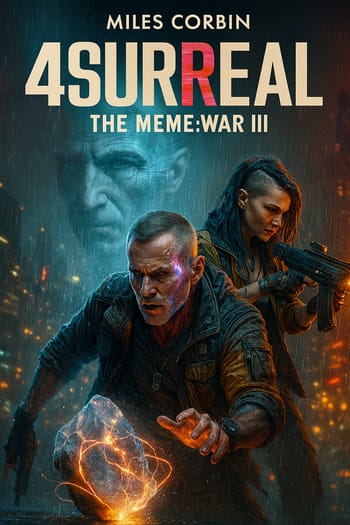
The rain had washed the chaos from the streets, leaving behind a clean, dark sheen on the asphalt. It smelled of ozone and wet concrete, the air scrubbed of the memetic residue that usually hung thick as pollen. They moved through the quiet canyons of the lower Symbiote Sectors, two ghosts in a city of sleeping puppets. Croft’s mind, for the first time in years, was a silent space. The two parasites, the Equity-Aggressor and the Patriot-Primal, were still there, coiled and waiting, but the frantic, contradictory shouting had been replaced by a low, steady hum. It was the sound of two engines at idle, a reservoir of power he was only just learning to steer.
Sabine led him to a public data terminal bolted to the wall of a transport depot, shielded from the rain by a crumbling overhang. It was an ancient piece of hardware, a thick slab of yellowed plastic with a physical keyboard, its keys worn smooth. A relic from a time before holographic interfaces and neural jacks became the primary vectors for infection. Sabine ran her fingers over the keys, a gesture of familiarity, of homecoming. She preferred the solid, tactile response of physical tech. It couldn’t lie to your nervous system.
She worked with a focused intensity, her fingers a blur. Lines of stark green code scrolled up the terminal’s grimy screen. She was building a wall of encryption around them, a temporary fortress of digital noise. Croft stood watch, his back to her, scanning the empty, rain-slicked plaza. He felt the absence of the Analyst, the ghost of his own reason, like a missing limb. The clean, white room of the REM Diagram was a shattered memory, and he was left with this: the grimy, imperfect reality of the world and the two sleeping monsters in his head. He was the room now.
— I’m in, — Sabine said, her voice low. — The connection is as clean as it’s going to get.
Croft turned. The screen now showed a single, pulsing cursor. A synthesized, multi-layered voice, a chorus of a thousand stolen speakers, filled the small space around the terminal. It was Echo.
— You have been busy, — the voice said. It was impossible to assign it a gender or an age. It was the sound of pure information.
Croft leaned forward, his hands gripping the edge of the terminal. He had to get this right. He had to speak the language.
— We need to introduce a beautiful flaw into a very large system.
There was a pause. The only sound was the hiss of rain on the pavement and the low hum of the terminal’s power converter. Then, a sound like a thousand people laughing at once, a dry, crackling wave of synthesized amusement, echoed from the speaker.
— I was hoping you’d call. The marker is due.
The feeling was not one of relief. It was the cold, clean snap of a trap springing shut. The price for their escape from the warehouse, for this very safe house, was now being called. Croft felt a low growl from the Patriot-Primal, a flicker of suspicion from the Equity-Aggressor. He silenced them with a thought. This was his negotiation, not theirs.
— We need access, — Croft said, his voice steady. — Schematics, entry codes, patrol routes. For the Panacea Protocols broadcast hub. The primary antenna.
— An ambitious flaw, — Echo’s voice replied, the amusement replaced by a tone of clinical interest. — You want to burn the sky.
Data began to flood the screen. Blueprints of the Panacea tower unspooled, a complex, three-dimensional wireframe of steel and concrete. Security drone patrol routes appeared as pulsing red lines. Power conduit schematics overlaid the structure in green. It was all there. The impossible plan suddenly had a map, and a flicker of hope, dangerous and bright, ignited in Croft’s chest.
— This is the key, — Echo’s voice stated as the last data packet downloaded. — Now for the price.
Croft’s hands tightened on the terminal. Sabine looked at him, her grey eyes sharp, her expression unreadable in the green glow of the screen. The marker was the price. That was the deal. But Echo was a broker of systems, and systems always had hidden costs.
— The marker gets you the data, — the voice said, as if reading his thoughts. — My help requires a further investment. When you are inside the broadcast system’s core, you will leave something for me. A backdoor. A permanent, privileged access point to the city’s cognitive infrastructure.
The air grew thick. The hum of the parasites in Croft’s head rose in pitch. This was not part of the plan. They were trying to free the city from one form of control, not hand the keys to another. To a ghost. A criminal. He looked at Sabine. Her face was pale, her jaw tight. She understood the monstrous nature of the request. They would be trading Panacea’s corporate tyranny for Echo’s chaos.
It was the kind of dirty, impossible choice the parasites could never make. Their moral frameworks were too absolute, too clean. For them, this would be a paradox error, a system crash. For him, now, it was just the world. A world of bad options and high prices. He thought of Kennet’s face as the scrambler hit him. He thought of the empty eyes of the people on the Silent Street. The price of doing nothing was certainty. The price of acting was this.
He gave Sabine a slow, deliberate nod. The choice was made. The price would be paid. He felt the weight of it settle in his bones, a cold, heavy thing. This was what it felt like to be free. It felt like responsibility.
Sabine’s fingers moved to the keyboard. She typed a single word.
AGREED
The connection terminated. The screen went dark, leaving them in the dim glow of the depot’s emergency lights. They had the tools for their final gambit. The resources for the attack were secured.
Sabine pulled the data-slate from the terminal and brought up the schematics of the Panacea tower. The image was terrifying. A sheer, windowless spire climbing two kilometers into the storm-tossed sky. Red lines indicating drone patrols swarmed around it like angry wasps. Energy field warnings pulsed at key structural points.
— Plan viability is low, — Sabine murmured, her voice flat. — I’d put it at 15%. Maybe.
Croft looked at the impossible climb, at the layers of lethal security. He felt the hum of his internal engines, ready and waiting. 15% was more than they had an hour ago. It was more than zero.
They had the schematics and the city's mind was the price.