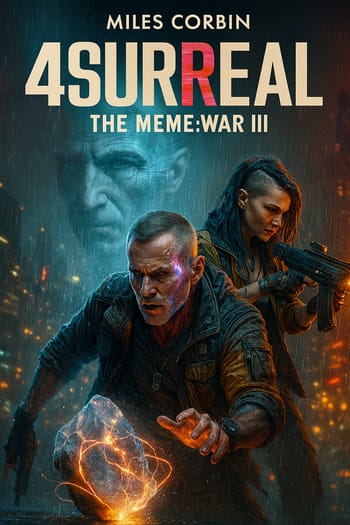
The wind was a solid thing, a wall of air and rain that wanted to peel him off the world. Two kilometers below, the Sprawl of Saint Protagoras had gone insane. The cognitive cascade he had unleashed was a city-wide seizure, holographic ads flickering between corporate slogans and nonsensical poetry. The orderly grid of CI-Div control and Panacea profit had been replaced by beautiful, harmless chaos. Their escape window.
He and Sabine ran for the eastern edge of the service platform, the grated metal slick and treacherous under their worn boots. The antenna array behind them was silent, its deep hum of power gone, leaving only the raw shriek of the storm. They were fugitives at the top of a dead god’s nervous system.
Sabine skidded to a halt near the edge, her breath pluming in the cold air. She held up the small, armored data-slate strapped to her forearm, shielding it from the worst of the rain. A single line of text glowed green against the dark screen, clean and brutally simple. Echo’s final instruction.
— Service barge, — she shouted over the wind, her voice raw. — Storm drain canal. Sixty seconds.
Croft looked over the edge. It wasn't a jump. It was a fall. A 200-meter drop into a churning black ribbon of water, a wound in the concrete canyon of the city. His mind, the part that wasn't a storm of warring parasites, did the math. Impact velocity. Surface tension. Hypothermia. The probability of survival was a rounding error. He hesitated, his feet feeling welded to the metal grate.
The price of their escape was the city. Their old lives, their connections, any possibility of a return to a world with rules. It was a one-way transaction.
He saw Kennet’s face, vacant and empty after the neural scrambler’s blast. He felt the phantom weight of the data-slate with the Weil Theorem, now lost in some filthy drainpipe. They had failed. He had failed. What was the point of this final, suicidal leap?
Sabine grabbed his hand. Her grip was surprisingly strong, her fingers cold and wiry.
— Together, — she said, her grey eyes locking onto his. It wasn't a question. It was a statement of fact. A law of their new, two-person physics.
Her thumb began to tap against the back of his hand. A soft, rhythmic pressure. Two taps. A pause. Three taps. A pause. Five. The prime number sequence. The same pattern she used to soothe herself, to focus her mind. It wasn't a code. It was a shared language, a private signal that bypassed the screaming logic of his fear. It was trust, rendered in tactile data.
The choice was no longer his alone. It was theirs.
He squeezed her hand, a silent answer. Together. They took a step back from the edge, a shared breath, and then they ran. They leaped from the roof together, two figures plunging into the storm-swept darkness, abandoning the world of systems and certainty for the simple, terrifying gravity of their choice.
The fall was a silent scream. The wind tore the air from his lungs. The city lights spun into a vortex of color. He held onto Sabine’s hand, the only anchor in a universe that had come completely unglued. He didn't think about the parasites. He didn't think about the Analyst or the clean, white room of the REM Diagram. He thought only of the pressure of her hand in his.
They hit the water. It was not a splash but a solid, brutal impact. The cold was a physical blow, a shock that drove the last of the air from his body and threatened to stop his heart. Darkness and disorientation. He was tumbling in the churning, filthy water of the canal, his limbs heavy, his lungs burning. He had lost her hand.
Panic, cold and absolute, seized him. He fought his way toward a surface he couldn't see, his waterlogged gear pulling him down. His head broke the water and he gasped, sucking in a mouthful of rain and canal spray. The concrete walls of the canal rose up on either side, slick with algae and glowing with the reflected, chaotic light of the city above.
He saw her, a pale face in the dark water ten meters away, struggling to stay afloat. He started swimming, his movements clumsy, his muscles screaming in protest. The exhaustion from the climb, from the cascade, was a lead weight in his bones.
Then, a shape emerged from the gloom. A large, rusty service barge, its engines running silent, gliding through the water like a ghost. It was real. Echo’s plan was real.
He reached Sabine, grabbing the collar of her jacket. She was shivering, her teeth chattering, but her eyes were clear and focused. They swam for the barge, a final, desperate burst of energy. The side of the hull was a wall of slick, cold steel.
He found a handhold, a rusted cleat, and hauled himself up, his body feeling impossibly heavy. He lay on the deck for a moment, gasping, the cold metal a welcome solidness beneath him. Then he reached down, grabbing Sabine’s outstretched hands, and pulled her aboard.
She collapsed beside him, a shivering heap on the wet deck. They were alive. They were freezing, exhausted, and had nothing but the clothes on their backs, but they were alive and they were free.
The barge moved silently down the canal, leaving the frenzied, babbling city behind. The rain began to soften, the roar of the storm quieting to a steady hiss on the water.
They had escaped. Now they were adrift in a world with no maps.