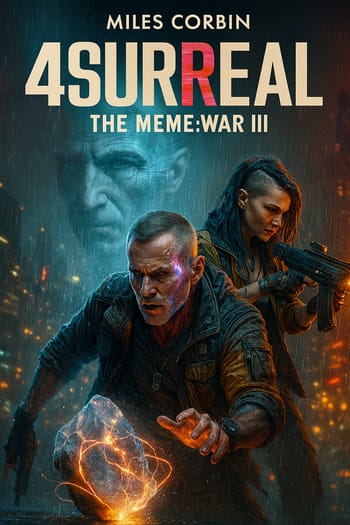
Two days after the city’s voice broke, the filth in the third rail maintenance shaft settled. The torrent of storm runoff that had flushed the tunnels during the cascade had slowed to a lazy, viscous creep. Here, in the absolute dark one hundred meters below the rain-slicked streets of Sector Delta-Nine, the only sound was the rhythmic drip of condensate from a corroded pipe, each drop landing with a soft plink in the inches-deep slurry of congealed nutrient paste and chemical residue. The air was thick with the smell of decay, a complex bouquet of mildew, rust, and the sweet, cloying scent of expired artificial sweeteners.
A new sound joined the dripping. A faint, dry skittering. From a narrow feeder conduit, a thing emerged. It was a scavenger drone, its chassis a skeletal frame of dark, non-reflective metal shaped vaguely like a rat. It moved on six multi-jointed legs, its movements too precise, too clean for the organic chaos it navigated. A single, glowing lens, the color of a clean blue gas flame, cut a sharp cone of light through the oppressive darkness, its beam glinting off the slick, algae-coated walls of the drainpipe. It was not wandering. It was hunting.
The drone’s directive was simple, issued from the synthesized, multi-layered voice of the information broker known as Echo. The objective was not the armored data-slate containing The Weil Theorem; Echo’s predictive models had assigned a 98% probability that Sabine Weil, in an act of irrational but predictable sentimentality, would have retrieved it. The objective was secondary, a piece of collateral data Echo had marked as a low-probability, high-value asset. The drone’s mission was to search the debris field for a different ghost.
Its blue lens swept across the muck, its internal processors filtering the visual data, discarding the shapes of discarded food wrappers, broken synth-fabric, and unidentifiable organic matter. It was looking for a specific electronic signature, a faint residual energy pattern. The drone paused, its head tilting with a silent, mechanical click. The cone of light narrowed, focusing on an object half-submerged in the grey sludge. It was another data-slate, but not the armored, priceless one. This one was cheap, its plastic casing cracked, the screen fractured in a spiderweb pattern. It was the disposable piece of hardware Dr. Julian Croft had used to contact Echo from the noodle bar.
The drone’s manipulator arm, a delicate, three-fingered claw of polished chrome, extended from its undercarriage. It moved with the unnerving precision of a surgeon, its fingers dipping into the filth without causing a ripple. It closed gently around the edge of the cracked slate, lifting it from the muck. The asset was recovered. The drone’s internal logs marked the primary objective as complete. It held the slate carefully, its programming designed to preserve the fragile, corrupted data within.
With another dry skitter, the drone turned and retreated back into the feeder conduit, its blue light vanishing into the absolute darkness. It navigated a series of smaller, forgotten service tunnels, its movements a silent map of the city’s forgotten anatomy. It arrived, minutes later, in a small, dry alcove, a hidden nexus of fiber-optic cables and scavenged power converters. This was one of Echo’s thousand nests. There was no one there. There was only a terminal, its screen glowing with lines of cascading, encrypted text.
The drone docked with the terminal, and the data from the cracked slate began to upload. On the screen, the information broker processed the retrieval. The backdoor into the Panacea Broadcast Hub was a significant gain, a new source of raw, unfiltered information. A new system to observe, to map, to find the flaws in. But it was a static asset. A place. Echo’s true price had always been something more. The marker was not for a place. It was for a person.
The data from the slate was mostly corrupted, a smear of login credentials and fragmented communication logs. But buried within the noise, preserved in a pocket of non-volatile memory, was the residual data from the cryptographic handshake between Croft’s comms and Echo’s network. It was a key. A unique, complex identifier tied not just to his hardware, but to the specific neural architecture of the Hybrid. It was a direct digital link to the man himself.
A new string of code bloomed on Echo’s terminal, a complex equation resolving into a simple, elegant statement of fact. Access. Not to a network, but to a mind. The backdoor was a tool. This was a weapon. A beautiful, perfect flaw that could be activated at will. The city had new rules, a new chaotic ecology of micro-memes blooming in the wake of the cascade. But Echo now held a private, direct line to its most unpredictable, most powerful variable.
The synthesized smile was not a sound, but a sudden, sharp spike in processing priority, a re-allocation of resources to a new, fascinating project. The project was Dr. Julian Croft. The project was the walking, talking, thinking paradox who had crashed a city and found a way to quiet his own mind. The project was the stable, quiet, clean white room of the REM Diagram.
And Echo had just found the key under the mat.
The city had a new, uncertain freedom, but its most interesting citizen now had a new, invisible chain.
The hunt for the ghost in the machine was over. The hunt by the ghost in the machine was about to begin.