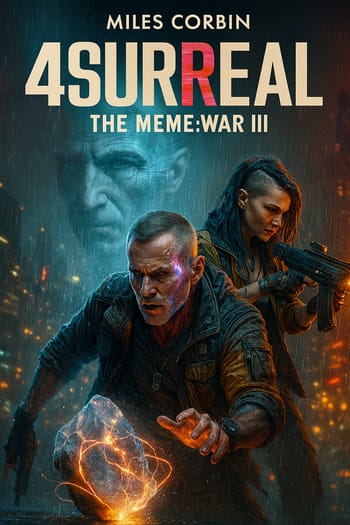
The Redaction Hub was a space scrubbed of information. Not data, which flowed in silent, holographic rivers across the walls, but the messy, biological information of life. The air, recycled to within a single part per million of absolute purity, smelled of nothing but the faint ozone tang of the electrostatic filters. The only sound was a pure 400-hertz sine wave, a clean tone that filled the cognitive space and left no room for the chaotic frequencies of music or speech. It was the sound of perfect order, and Cyprian Hasek let it wash through him as he observed the city.
A three-dimensional map of The Sprawl of Saint Protagoras floated in the center of the room, a shimmering ghost of concrete and light. Hasek’s eyes were fixed on a stain spreading through its southeastern quadrant. It was not a color, but an absence of color. A void. Sector Gamma-7, a district once boiling with the clashing signals of a dozen memetic infections, had gone dark. Every Somatic Sigil, the bio-implants that broadcasted a host’s ideological allegiance, had ceased transmission. The silence was spreading at a rate of one city block per hour. It was a cancer of nothing.
Hasek adjusted the volume of the sine wave, a micro-adjustment of a single decibel, an everyday ritual of environmental tuning. The spreading void on the map was an impurity in the system, a statistical anomaly that offended his sense of order. It was a problem that required not understanding, but excision. With a precise gesture, he opened a holographic channel. The air shimmered, and the dispassionate face of Chief Commissioner Wardell Holland materialized above the map, his features a study in engineered neutrality.
— Commissioner, — Hasek began, his voice as flat and clean as the room’s acoustics. He gestured toward the spreading darkness on the map.
— Sector Gamma-7 is experiencing a total signal loss. A null-state contagion.
Holland’s grey eyes blinked once, slowly. He was the system’s ultimate pragmatist, a man whose mind ran on the pure, cold logic of the procedural manuals he was sworn to uphold. He was not a man of action, but a man of reaction, a human firewall designed to prevent hasty decisions.
— I have the report, Director. The data is incomplete.
— The data is perfectly complete, — Hasek countered, his tone hardening by a fraction. He had no time for Holland’s procedural inertia.
— It shows an absence. This is not an outbreak of a new belief. It is a void. It requires surgical removal, not study.
He framed the event in the only terms that made sense: pathology. You do not study a tumor; you cut it out before it metastasizes. The silence from Holland’s end was a calculated pause, a tactic Hasek recognized and despised. It was the sound of a man consulting a rulebook while the patient bled out.
— Protocol 7.4.a is clear, — Holland’s voice finally came, each word a perfectly formed unit of bureaucratic certainty.
— Anomalous memetic phenomena of an unclassified nature require investigation by a cognitively diverse asset prior to any redaction authorization.
The words were a physical check on Hasek’s authority. Holland’s adherence to protocol was absolute, a perfect 100%. It was his strength and, in Hasek’s view, his most profound weakness. Hasek felt a flicker of contempt, a messy spike of emotion he immediately suppressed. He adjusted his tactic. If he could not attack the problem, he would attack the proposed solution.
— A cognitively diverse asset, — Hasek said, letting the term hang in the air like a bad smell.
— You mean the Hybrid. You intend to send a walking contamination into a sterile field.
He gestured again, and a new window opened beside Holland’s face. It displayed a chaotic, flickering graph, a visual representation of the data pulled from Dr. Julian Croft’s REM Diagram. It was a mess of intersecting lines and violent spikes, the raw output of a mind at war with itself. It was the image of a system failure.
— His internal conflict makes him unpredictable. The risk of him being compromised, or worse, becoming a new vector, is unacceptable. My assessment places the probability of mission corruption at 95%.
Holland’s gaze shifted to the graph, his expression unchanging. He was not seeing the chaos Hasek saw. He was seeing a tool, one designed for a specific, unpleasant purpose. The Hybrid was an anomaly meant to analyze other anomalies. It was a dirty job, and Croft was the only one dirty enough to do it.
— The protocol is clear, Director, — Holland repeated, his voice losing none of its synthesized calm. He was immovable.
— Deploy the Hybrid.
The order was direct. It was absolute. It was a checkmate. Hasek’s jaw tightened. He was being forced to use a flawed, contaminated instrument. He was being ordered to risk the purity of the entire system on the stability of a man who argued with himself over nutrient paste in a supermarket. The status in the room had inverted; Hasek, the Director of Redaction, was being dictated to by a walking manual.
— As you command, Commissioner. — The words were acid in his mouth.
He terminated the call. Holland’s face dissolved into the clean air.
Hasek stood alone in the silence, the pure sine wave doing little to calm the dissonant frequency of his rage. Holland had not just overruled him; he had revealed the flaw in the system. The system protected its own procedures even at the cost of its own health. If the system would not purify itself, Hasek would have to do it from within. He had been given an order, and he would follow it. To the letter.
He moved to his private console, a slab of black, non-reflective ceramic set into the wall. His fingers danced across its surface, calling up Dr. Julian Croft’s operational file. He would deploy the Hybrid, as ordered. But he would do so under his own terms. The price of this decision was a small tear in the fabric of his own perfect procedural record, a necessary compromise to achieve a greater purity.
First, he flagged the mission file for high-scrutiny monitoring. Every piece of data, every biometric reading, every scrap of communication from Croft’s mission would be routed directly to the Redaction Hub. He increased the surveillance level by 200%, turning what should have been a field investigation into an audit under a microscope.
Next, he accessed the mission’s resource allocation. He stripped it of all non-essential support. No priority access to satellite imaging. No backup tactical teams on standby. No discretionary funding. He was giving Croft a knife and sending him to a gunfight, ensuring that if the Hybrid failed—as Hasek was certain he would—the failure would be catastrophic, undeniable, and entirely Croft’s own. It was a clean, logical solution.
He reviewed the file one last time, his eyes lingering on the chaotic visualization of the REM Diagram. It was a map of a diseased mind, a space that could never be truly scrubbed clean. It was everything he fought against. Croft was not an asset; he was a symptom. And symptoms needed to be observed, documented, and, when the time was right, erased.
With a final, decisive tap, Hasek transmitted the deployment order to Croft’s handler, Dr. Oran Kennet. The mission was active. The Hybrid was in play. The board was set.
The pure sine wave hummed, a perfect, unbroken line of sound. The dark stain on the holographic map continued its slow, silent spread.
Holland had just made the Hybrid a necessary sacrifice.