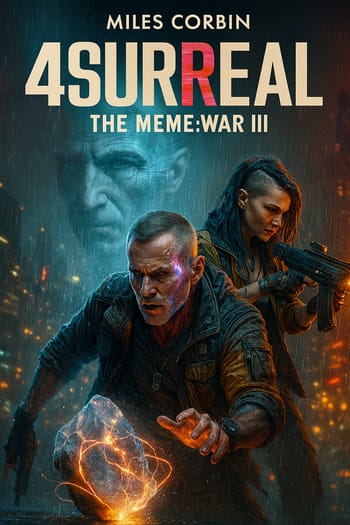
The door slid shut, and the world collapsed into absolute darkness and the smell of ozone and hot dust. Before Croft’s eyes could adjust, a sharp, metallic click echoed in the confined space. A single, blinding point of light flared, a weapon-mounted tac-light that bleached his vision to white noise. From the heart of that glare, a voice, raspy and dry as old paper, cut through the silence.
— You smell like the system.
The barrel of a handgun, a perfect black circle against the overwhelming light, was pointed directly at his face. His parasites screamed. The Equity-Aggressor shrieked about systemic violence and the oppressive nature of armed confrontation. The Patriot-Primal roared with indignation, a primal fury at being cornered and threatened. The noise was a physical pressure inside his skull, a feedback loop of panic and aggression that threatened to lock his muscles. He fought it down, forcing the Analyst’s training to the surface. Assess. De-escalate. Survive.
He slowly raised his hands, palms open and empty. The gesture was universal, a piece of wet-wired primate code that predated any memetic infection. It was a signal he hoped this rogue engineer, this ghost named Sabine Weil, would still understand. The light didn't waver.
— I’m not here to hurt you, — he said, his voice steady, a carefully constructed lie. He was a tool of the system that hunted people like her. He was absolutely here to hurt her, just not in the way she expected.
— Everyone from the system says that, — the voice rasped. — It’s part of the introductory script.
He needed to offer a better gesture, a more significant sacrifice. His left hand moved with deliberate slowness toward his wrist. He tapped the face of his CI-Div comms unit, the small screen glowing with the Division’s sterile grey logo. With a final, decisive press, he deactivated it. The screen went dark. He had just severed his only line to Kennet, his only connection to the vast, broken machine that owned him. The choice cost him his last shred of plausible deniability. He was no longer a stray dog on a long leash; he was a cut line, drifting in the dark.
The price was paid. Now for the offering.
— I have something for you, — Croft said, his hand moving with the same glacial pace toward the inner pocket of his jacket. — A problem. I’m told you like problems.
He withdrew the sealed, grey data-slate Kennet had given him. It held the sample of the Hush Meme, the digital ghost of the silence that had consumed Sector Gamma-7. He held it out, an offering between them. It was an act of profound vulnerability, giving her the very object of his mission. He was betting everything on a single hypothesis: that her curiosity would be a stronger parasite than her paranoia.
The light from her weapon dipped slightly, illuminating the slate. For a long moment, the only sound was the hum of overloaded power converters and the distant drip of water. The light moved from the slate to his face, a clinical examination. Her gaze lingered on his right temple, and he knew what she was seeing.
His Somatic Sigils, no longer suppressed by the mission’s urgency, were flickering. A frantic, unstable pulse of magenta and electric blue. The Equity-Aggressor and the Patriot-Primal, both agitated by the confrontation, were broadcasting their conflict for anyone to see.
The gun lowered another few centimeters. The blinding light shifted, no longer aimed at his eyes but at his chest. He could see her now, a silhouette against the glare. A woman, lean and wiry, with one side of her head shaved clean and a tangle of matted blue hair on the other. Data-ports, old and mismatched, were embedded in her temples.
— A Hybrid, — Sabine Weil whispered, the word a strange mix of disgust and reverence. The hunter’s focus in her eyes was gone, replaced by the keen, obsessive glint of an analyst who had just stumbled upon a priceless data anomaly. — You’re a walking system failure.
She paused, a slow smile spreading across her face. It was not a friendly smile. It was the expression of a biologist who had just discovered a creature previously thought to be mythological.
— Interesting.
Her paranoia, a shield built over years of being hunted, had been overridden by the sheer, beautiful novelty of his existence. He was not just another agent. He was a paradox, a living contradiction to the binary world of memetic infection. He was data. He was a puzzle.
She took the data-slate from his outstretched hand, her fingers brushing his. Her skin was cold. The gun, a battered but well-maintained Kessler-9 pistol, was finally lowered completely, its tac-light clicking off. The sudden darkness was a relief. Emergency lights flickered on, casting the space in a dim, reddish glow.
— Come in, — she said, her voice losing some of its rasp. — Don’t touch anything. Most of it will kill you.
He stepped past her into the workshop. It was the belly of a scavenged transport van, a chaotic nest of wires, mismatched server racks, and stacks of scavenged hardware. The air was thick with the smell of solder and the electric tang of a Faraday cage, the shielding that kept her hidden from the world. It was the absolute antithesis of the REM Diagram, the clean white room of his mind. That space was pure logic, a sterile grid of light. This was a physical manifestation of chaos, a system grown organically from junk and desperation.
A half-eaten nutrient bar sat on a console next to a mug of black, viscous liquid that might have been coffee. Wires snaked across the floor like metallic vines. It was a mess, but it was a functional mess. Every piece of junk had a purpose.
Sabine Weil moved to a central console, a Frankenstein’s monster of different computer parts bolted together. She plugged the data-slate into a port with a decisive click. Her fingers flew across a keyboard, the plastic yellowed with age. She didn’t use a modern holographic interface. She used a command line, her inputs a blur of archaic code.
— So, the system finally found something it can’t scrub, — she muttered, more to herself than to him. — And they sent their pet monster to fetch the witch. It’s almost poetic.
Croft watched her, his own internal noise settling. The parasites were still there, but their frantic screaming had subsided into a low, suspicious grumble. The immediate threat was gone, replaced by a shared objective. It was a fragile truce, both internally and externally. This alliance was purely transactional, a temporary alignment of interests. But it was a step away from the absolute, parasitic belief that had paralyzed him in the supermarket. It was a choice, born of reason and necessity.
Data streams scrolled across her main monitor, lines of green and amber code that meant nothing to him. He saw her eyes narrow, her focus absolute. She was dissecting the Hush Meme, peeling back its layers with a surgeon’s precision. He recognized the intensity. It was the same look he saw in the mirror when the Analyst was at work in the REM Diagram.
For several minutes, she was silent, lost in the data. The only sounds were the clicking of her keyboard and the hum of the van’s life support. He stood perfectly still, a guest in a predator’s den, careful not to make any sudden moves.
Finally, she leaned back, running a hand over her shaved scalp. She let out a long, slow breath.
— It’s clean, — she said, her voice flat. — Too clean.
She swiveled in her chair to face him. Her grey eyes were sharp, analytical.
— This is just the agent. The raw code. There’s no delivery mechanism, no environmental markers, no host degradation patterns. It’s like you handed me a bullet and asked me to describe the gun that fired it.
She gestured at the screen, where a complex, rotating molecule of code was displayed. It was elegant, symmetrical, and utterly sterile.
— To understand what this is, and who made it, I need the context. I need the distribution vector.
She stood up, grabbing a worn jacket from the back of her chair.
— I need a sample of the product they used to spread it.
The hum of the servers seemed to grow louder in the sudden silence. The fragile safety of her shielded workshop was already dissolving. She was telling him they had to go back out. Back into the noise, back into the city that was actively being hunted by at least two different groups of people who wanted them dead.
His mission had been to find her. He had succeeded. But in doing so, he had only discovered a new, more dangerous objective.
To find the source of the silence, they had to return to the heart of the storm.