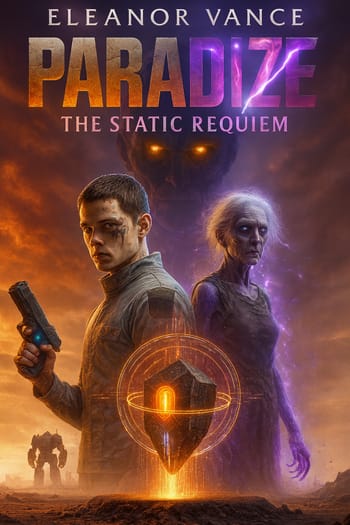
The twelve-meter Warden moved like a man made of steel and ruin, its gait a heavy, rhythmic crunch across the grey dust. Inside the cockpit, Rhys Carrick was a ghost welded to a machine, his hands moving with a practiced economy over controls worn smooth by the thumbs of dead pilots. The world outside was a smear of rust-colored earth and a sky the color of a dead screen, a perpetual twilight that promised neither day nor night. His patrol route, designation seven, was a familiar scar carved into the desolation of the Grey Wastes, a line drawn to keep the sane world in and the mad world out.
Each step of the war machine was a tremor he felt in his bones, a fusion of man and metal so complete he sometimes forgot where the hydraulics ended and his own sinews began. The primary function of the patrol was presence. A reminder that the Babylon Compact and its logic still held dominion over this stretch of poisoned land. He was a component in that logic, a moving part in a system designed for absolute order.
The air in the cockpit smelled of ozone and recycled oxygen, a sterile scent that never quite scrubbed the faint, underlying odor of hot metal and old fear. He ran a hand over the console, the cool plastic a familiar anchor in the humming solitude.
A steady, rhythmic clicking filled the cockpit, a sound so constant it had become a form of silence. The Geiger counter, his companion in the long hours. It was the song of the wastes, the slow, metronomic pulse of a world that had tried to die and failed. The readout glowed a placid green: ambient radiation holding at 5.2 millisieverts per hour. A lethal dose for the unprotected, but for him, inside the armored shell of the Warden, it was just baseline noise. The price of existence.
The clicks were a comfort. They were a known variable, a danger that could be measured, quantified, and shielded against. It was the unmeasured things that frayed the nerves. The silences between the clicks.
Then, a flicker. On the Geist Window, the sweeping laminate display that translated the world into tactical data, a phantom signal bloomed and vanished. It was less than a half-second of light, a sub-signature anomaly that didn't resolve into the shimmering distortion of a Glass Echo or the hard return of an enemy contact. The system logged it, flagged it as a low-priority glitch, and moved on. A ghost in the machine.
Rhys’s focus narrowed. His training screamed sensor ghost, a common byproduct of patrolling the fringes where the laws of physics had grown thin and frayed. But it hadn't felt like a ghost. It felt like a whisper. He kept the machine moving at a steady forty kilometers per hour, his eyes fixed on the screen, waiting for it to happen again. It did not.
He tapped a command into his console, the keys clicking softly under his glove. The machine’s archives spooled, cross-referencing the phantom’s fleeting signature against the Compact’s vast library of known phenomena. He searched for a match, a precedent, anything to file the anomaly away into a neat, logical box. The search took less than a minute, a torrent of data scrolling past his eyes.
The result came back cold and absolute. No match found. The system was 99% certain the signal did not correspond to any known Glass Echo or Chorus energy pattern. The anomaly remained unexplained, a loose thread in the perfect tapestry of the machine’s logic. A low-level hum of unease started in the back of his mind, a dissonance his training couldn't silence. He pushed it down. Doubt was an inefficient variable.
He initiated a routine check of the nutrient synthesizer, a small, mundane act of order. The machine whirred, processing the grey paste that kept him alive. It was another part of the system, another perfect, closed loop. Sustenance without flavor, life without living. He took the offered packet, the plastic warm in his hand.
A sharp, three-tone alert cut through the cockpit. An encrypted directive. His attention snapped back to the main display. A seal of interlocking gears materialized on the screen, the sigil of Tower-7 Command. Below it, a name that carried the weight of absolute authority: Director Joris Crane. The directive overwrote his current patrol route, the data packet unlocking a new vector that sliced southeast, away from his designated path.
The new route was a sharp, thirty-eight-degree turn that would take him toward the volatile border of a known Eden. The territory of the Chorus. His hand hovered over the acknowledgment key. Orders were orders. Unquestioning obedience was the first principle of the Compact, the load-bearing wall that kept their fragile world from collapsing. But this order, arriving moments after an unexplained anomaly, felt different. It felt like a response.
He suppressed the thought. It was a dangerous path, connecting events without sufficient data. That was how pilots went mad in the wastes, seeing patterns in the static. He pressed the key.
"Acknowledged," he said, his voice a dry rasp in the enclosed space.
The Warden pivoted, its heavy feet churning the dust as it settled onto the new heading. The machine’s systems calculated the new travel time: forty-five minutes to the edge of Bracket Nine. Forty-five minutes closer to the one place his machine was not designed to be. He could feel the unease again, a cold pressure behind his eyes. He chose to ignore it. The price of obedience was a quiet mind.
The landscape began to change. The rust-colored plains gave way to ground fractured with black, glassy veins. The air outside, according to his sensors, grew thick with a different kind of energy, something that felt less like poison and more like a presence. The steady clicking of the Geiger counter remained unchanged, but the Geist Window began to show faint, shimmering artifacts at the edge of its range.
A proximity alert chimed, soft but insistent. The Warden’s systems confirmed the obvious. They were closing on the Eden’s border, now just twenty kilometers out. The energy signature was faint but unmistakable, a Chorus-type radiation that corroded machine logic as surely as it twisted flesh. This was no longer a routine patrol. This was a high-risk incursion.
His unease hardened into suspicion. The phantom signal, the sudden change in orders, the vector toward an Eden. They were connected. He knew it with a certainty that defied his training. He needed to prove it, to find the flaw in the system’s logic or in his own.
He ran a level-two diagnostic on the Geist Window’s sensor array, a deep, invasive check of the hardware and its software. He watched the lines of code scroll, the system meticulously testing every circuit, every connection, every line of its own being. For a full minute, the machine turned its gaze inward, searching for the source of its own ghost.
The result was a single, damning word on the screen: NOMINAL. All systems were functioning perfectly. There was no hardware fault, no software corruption. The phantom signal had not been a simple malfunction. It was real. The system had seen something it could not understand, and his commander was sending him directly toward it.
The machine was perfect. The orders were clear.
The ghost in the machine was now leading the way.