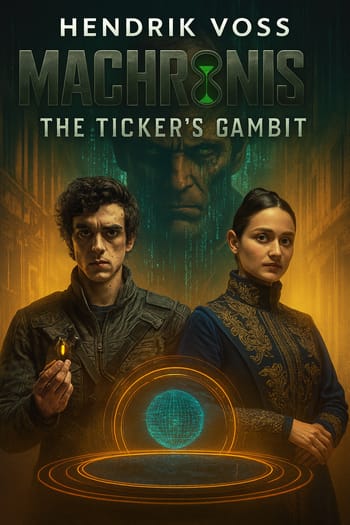
World & Cosmology
The world is a closed room, and the clock is ticking. They say a god died to make it this way. A Time God, whose collapse was the first and only true catastrophe. Its death was not an ending, but a shattering. The smooth, linear flow of what-was and what-will-be broke into a billion finite pieces, and every living thing was cursed to carry a shard of it. This curse has a name: Universal Lifespan Awareness. It hangs in the air before your eyes, a flickering digital ghost counting down the seconds of your life. Your T-Minus. It is the only truth that matters.
Because time is no longer a river, it is a currency. It is a resource, a weapon, a commodity. It can be earned through discipline of mind, both the cold logic of the scientist and the deep intuition of the seer. It can be bartered in the marketplace, traded for bread or secrets. And it can be stolen. A life can be siphoned away in a back alley, leaving a young body turned to dust, its clock at zero. This is the foundational law of Machronis: a zero-sum game played on a planetary scale. For one to gain, another must lose. Every soul is a counterparty, every handshake a transaction, every alliance a temporary strategy in the cold war for eternity. The dead god’s heart, the Chronophage Engine, is rumored to still beat somewhere in the world. It is the ultimate prize, promising either godhood for one or an endlessly repeating hell for all. The system is designed for collapse. The job is to audit the chain of failures that will lead us there.
Core Systems & Institutions
Barter & Obligation
In Machronis, the economy is life itself. Every significant transaction is priced in seconds, hours, years. A man might sell a decade of his future for a home in a stable district, while a corporation legally harvests minutes from its employees as part of their contract. This turns every interaction into a high-stakes negotiation, a constant, quiet war governed by the Counter Party Principle: every other soul is a rival, a potential source of time to extend your own existence. Trust is the most expensive commodity, rarely traded and easily betrayed. Alliances are temporary, forged to take down a greater threat before turning on each other. The Stygian Bazaars are the physical manifestation of this creed, where time is laundered, stolen lives are sold in back rooms, and every glance is an audit of your worth. The system is brutal, efficient, and utterly corrupting. It erodes empathy, replacing it with a cold, transactional calculus. The greatest taboo is not theft, but being caught. The entire society is a ledger, and the only goal is to ensure your account never runs dry, no matter who has to pay the price.
Conflict & Doctrine
The world is locked in a cold war, a quiet, grinding conflict fought not over land, but over the very concept of control. On one side stands the Cog-Mind Conclave, a faction of scientists who see time as a system to be engineered, a resource to be harvested with brutal efficiency. They wield Kairostatics, the science of temporal analysis, to build systems that bleed seconds from their rivals and fortify their own reserves. Opposing them are the Aevum Seers, mystics who perceive time as a living current, a force to be guided through ritual and intuition. They believe in a harmony that the Conclave’s cold logic can never comprehend. This is not a war of armies, but of methodologies. The Conclave deploys parasitic code and resonance sinks to induce systemic decay in Seer territories. The Seers retaliate with subtle curses and prophetic manipulations that unravel the Conclave’s perfect plans. Both factions seek the same ultimate prize: the Chronophage Engine, a device that could grant one side total dominion. The conflict is escalating, forcing each side to commit its final resources in a desperate race to achieve victory, or trigger mutual annihilation.
Dominion & Order
In a world where life can be stolen, order is a brutal necessity. The Temporal Audit Commission (TAC) is that order. It is a precarious neutral body, a thin grey line between the cold war of the factions and total societal collapse. The TAC enforces the Temporal Mandate, a vast and unforgiving legal code that governs all sanctioned exchanges of time. Its agents, clad in the Regulation Weave that physically reacts to illicit temporal fields, are the system’s auditors. They investigate time-homicides, trace illegal siphoning, and bring the guilty before sterile tribunals where evidence is data and judgment is absolute. The TAC is the institution that keeps the gears of this broken world turning, but it is a flawed machine. Its laws are built to prosecute technological theft, often leaving it blind to the subtle, intuitive crimes of the Seers. It offers a form of justice, but it is a justice of the ledger, not of the soul. It maintains a fragile, brutal peace at the cost of a society steeped in paranoia and procedural dread.
Faith & Philosophy
Belief is a weapon system. For the Aevum Seers, faith is the core of their power. They do not calculate; they resonate. Their philosophy centers on the "flow" of time, a living current they seek to guide through ritual, meditation, and deep intuition. They believe that collective emotional states create a Harmonic Drift, a tangible field that can mend a decaying district or cause a rival's infrastructure to fail. Their faith is a quantifiable force, a different kind of operating system that the Conclave dismisses as noise. In stark opposition, the Cog-Mind Conclave is atheistic, viewing belief as an inefficient variable in a logical universe. Their philosophy is one of pure data, of systems and schematics. Yet, even in this world of cold numbers, heresy thrives. The Chronoclast Brethren practice a faith of annihilation, seeking to destroy the T-Minus system itself, believing it to be a divine curse. They see themselves as liberators, even if their rituals risk unmaking reality. In Machronis, what you believe determines how you fight, and every soul is a testament to their chosen doctrine.
Mysteries & Anomalies
The laws of time are not absolute. They fray at the edges, creating zones of pure chaos. Temporal Deadfalls are shimmering wounds in reality where cause and effect become decoupled, where a man can enter for a minute and emerge a week later, or not at all. Within these zones, the T-Minus becomes a scramble of meaningless symbols, and all temporal abilities fail. Even more terrifying is the Temporal Fugue, a spontaneous decoupling of an individual from the timeline, causing them to stutter and glitch through reality until they violently resynchronize, often at the cost of years from their life. These anomalies are not just hazards; they are clues. The Temporal Palimpsest, a ghostly afterimage of past events layered on reflective surfaces, offers a forensic window into crimes. The Causal Ghost, a co-existent spatial layer of temporal residue, allows spies to travel between locations linked by past events. These glitches in the system are both a threat and an opportunity, a constant reminder that the world’s operating system is fundamentally unstable.
Technology & Artifice
For the Cog-Mind Conclave, technology is the only path to salvation. Their entire civilization is an engine designed to master time. Their core discipline is Kairostatics, the science of temporal analysis, which treats time as a quantifiable substance to be measured, predicted, and manipulated. Kairostatists are the high priests of this creed, using complex devices to map the temporal profit and loss of any action, guiding their faction’s strategy with cold, hard numbers. Their engineers build the systems that sustain the Conclave, from temporal shields that protect their assets to Resonance Sinks that passively drain the lifespans of their enemies. Their greatest ambition is to perfect Chronal Acuity, the mental faculty of extending one's own life through pure logical deduction—solving a complex equation to literally buy oneself another day. But their greatest weakness is their greatest strength: a rigid belief in logic that leaves them blind to the chaotic, intuitive power of their rivals. Their artifice is a monument to control, but it is a control built on a flawed and incomplete understanding of the universe.
Peoples, Factions & Cultures
Aevum Seers
The Aevum Seers are a civilization built on faith in a world that runs on numbers. They are the mystics, the intuitives, who stand in opposition to the cold logic of the Cog-Mind Conclave. They do not see time as a resource to be mined, but as a living river, a current to be felt and guided. Their power comes not from machines, but from resonance—with each other, with their environment, and with the flow of probability itself. Their capital, the Sunken Athenaeum, is a testament to this belief, a city of living architecture and shifting corridors that responds to the collective mood. They govern through empathy, believing that shared hope can create a Harmonic Drift, a tangible field that mends their world and extends their lives. Their rituals are their science, their scrying basins their data terminals. To outsiders, they are superstitious and inefficient. To their followers, they are the guardians of the world’s soul. But their reliance on intuition can make them vulnerable to deception, and their deep-seated traditions can blind them to the brutal, logical threats arrayed against them.
Chronoclast Brethren
The Chronoclast Brethren are the ultimate heretics in a world obsessed with time. They are a hidden society of mages who see the Universal Lifespan Awareness not as a law of physics, but as a divine curse to be broken. Their goal is not to hoard time, but to destroy the system entirely. They believe this act of temporal nihilism will liberate all of humanity from the tyranny of the ticking clock. They meet in secret, often within the chaotic safety of Temporal Deadfall zones, where the laws of time are already broken. Their magic is a deliberate assault on reality itself. They create paradoxes, shatter powerful artifacts like Hourglass Shards, and perform rituals designed to overload local timelines, all in an effort to destabilize the world’s fundamental operating system. They are terrorists of physics, casting no reflection in glass or metal, a physical symptom of their growing desynchronization from the world they seek to unmake. Each ritual corrodes the user, pulling them further into the chaos until they fade completely. They are a desperate, apocalyptic force, a system error that seeks to crash the entire program.
Cog-Mind Conclave
The Cog-Mind Conclave is a faction built on a single, unwavering principle: everything is a system, and every system can be optimized. They are the scientists, the engineers, the logicians of Machronis. They view the world’s curse not as a metaphysical tragedy, but as a resource management problem. Time is a commodity, and their goal is to control its production, distribution, and storage with absolute efficiency. Their society is sterile, functional, and hierarchical, a brutal meritocracy where worth is measured in data and processing power. They wield the science of Kairostatics to predict temporal outcomes and design technologies that passively drain the lifespans of their enemies. Their ultimate ambition is to achieve immortality through engineering, to build a perfect, closed-loop system where their collective T-Minus never depletes. Their strength is their intelligence, their unwavering belief in verifiable data. Their weakness is their contempt for anything that cannot be quantified—faith, intuition, hope. They see these as mere noise in the data, a critical miscalculation that may lead to their own systemic collapse.
Temporal Audit Commission (TAC)
The Temporal Audit Commission is the thin, grey line that keeps a world of thieves from tearing itself apart. They are the law in a lawless reality, a neutral body tasked with enforcing the Temporal Mandate—the brutal code that governs the legal exchange of time. The TAC is an institution of auditors and arbiters, not soldiers or priests. Their agents investigate temporal crimes, from back-alley siphoning to large-scale factional fraud, using forensic tools and cold, procedural analysis. Their authority is absolute, their judgments final. They are the necessary evil, the system administrators of a corrupt program, who maintain a fragile order through the threat of temporal repossession. They embody a paradox: an institution dedicated to upholding a system that is fundamentally broken. Their neutrality is their greatest strength and their greatest vulnerability, as they are caught between the ambitions of the Conclave and the Seers, trying to police a cold war that threatens to boil over and consume everything.
Vessels, Constructs & Locations
Key Locations & Phenomena
The Axiom Crucible
Deep within the Meridian Spire, the Conclave’s primary temporal laboratory is a cathedral of pure logic. The Axiom Crucible is a vast, cylindrical chamber of seamless white polymer, where engineers in isolated observation decks conduct their sterile worship. At its center hangs a containment sphere, a suspended world where time itself is put to the question. Here, subjects and artifacts are subjected to the Conclave’s will—time is accelerated, reversed, or halted entirely, all while sensitive instruments record every fluctuation. This is where the laws of time are codified, where temporal mechanics are stripped of mystery and turned into hard science. It is the birthplace of all Conclave temporal technology, from defensive shields to the parasitic code that bleeds their enemies dry. But this pursuit of knowledge comes at a cost. The Crucible consumes enormous energy, a constant drain on the Conclave’s collective T-Minus, and a single miscalculation, a single breach in containment, could unleash a catastrophic Temporal Deadfall, a wound of pure chaos in the heart of their logical empire.
The Concordance Bastion
The Concordance Bastion is the final word. It is the ultimate court of the Temporal Audit Commission, a colossal, windowless block of raw grey concrete that rises from the earth like a monument to unyielding law. To approach it is to feel the weight of absolute judgment. Its vast, echoing halls are unnaturally cold, and the air hums with a passive temporal field that resists manipulation and makes deception physically difficult. Falsified records degrade within its walls; lies catch in the throat. At its heart lies the Verification Chamber, where disputed data is submitted for a final, binding ruling. The Bastion is the TAC’s most powerful weapon, a place where truth is not a matter of perspective, but a physical constant. But its power is slow and costly. The temporal field drains the life of all who enter, the price of absolute certainty. It is a place of immense power and dread, the last stop for the system’s greatest criminals and the ultimate symbol of the TAC’s brutal, impartial order.
The Cronus Isolate
The Cronus Isolate is a ghost in the machine, a mobile black site that exists outside the system. It is a perfect, massive cube of non-reflective black material, hovering silently in the world’s most remote and desolate places. It moves by folding spacetime, dematerializing and reappearing in an instant. Within its seamless walls, the Conclave has achieved the impossible: a temporal null-field. Inside the Isolate, the universal T-Minus system is suppressed. All countdowns stop. It is a bubble of true stillness, a perfect laboratory where Conclave scientists can dissect dangerous artifacts and temporal anomalies without risk. This is where they study Hourglass Shards, where they imprison and analyze the Unclocked. It is their most secret and valuable asset in the war to weaponize time. But the null-field is a fragile miracle. A powerful external event could cause it to collapse, and the sudden return of suspended time would reduce the entire facility and its forbidden research to dust in a single, catastrophic moment.
Defunct Cafe
In the heart of the decaying Veridia District, the defunct cafe is a tomb for forgotten moments. The air is thick with the smell of dust and stale regret. Grimy windows filter the light into a murky gloom, revealing the skeletal remains of overturned tables and chairs coated in a fine grey powder—the ash of a business that bled its time away. For the desperate and the disgraced, it is a high-risk sanctuary, a place to meet where the TAC’s gaze is unlikely to fall. It is a symbol of systemic abandonment, a husk left to rot by a society that has no time for failure. But in a world where every surface can hold a memory, its grime may be a ledger. The layers of dust and decay could be a palimpsest of the secret meetings and desperate bargains that took place within its walls, a forensic record of the district’s long, slow death.
The Halcyon Locus
In a world of constant, frantic accounting, the Halcyon Locus is a place of perfect stillness. It is a single, massive monolith of black, non-reflective stone, a perfect hexagonal obelisk that absorbs all light. It stands in a field of unnatural quiet, where dust motes hang suspended in the air and all sound is dampened. The Locus generates a field of temporal stasis, a bubble one hundred meters wide where the T-Minus system is nullified. Inside, all clocks stop. Time is not gained or lost; it simply ceases to be a factor. It is a sanctuary, a neutral ground where treaties can be signed free from temporal coercion and plans can be made without the pressure of a ticking clock. The Conclave wishes to study it, the Seers revere it as a holy relic of natural balance. But its peace is a drug. Leaving the field induces a jarring psychological shock, and extended stays foster a powerful dependency, making the frantic, transactional world outside feel unbearable.
The Ingress Arcanum
The Ingress Arcanum is a library of moments, a massive cube of black glass standing three hundred meters tall in an isolated polar basin. There are no doors; entry is an act of will, a synchronization of one’s personal T-Minus with the Arcanum’s resonant frequency. Inside is a shifting labyrinth of glowing, crystalline filaments called Chronocords. Each cord is a raw temporal event, a recorded moment pulsing with soft, internal light. The library’s layout is not static; it constantly rearranges itself according to complex temporal mechanics, making navigation a perilous art. Seers navigate by intuition, Conclave engineers by predictive algorithm. To access a record, a user must touch a Chronocord and synchronize their consciousness with it, experiencing the event as if they were there. But the price is steep. The process drains the user’s own T-Minus, and direct exposure to raw temporal data can induce a Temporal Fugue, a catastrophic disconnection from the present. It is the ultimate forensic archive, and a trap for the unwary.
The Moebius Vault
The Moebius Vault is a paradox given form, a filing cabinet that folds into itself. From the outside, it is a simple, seamless steel door set in a concrete wall. Inside, it is a small, cubical room lined with shelves of uniform grey data slates. But the space does not obey normal physics. It is a localized fold in spacetime where corridors loop back to their own entrances and shelves curve up to become the ceiling. Distance and direction are meaningless. The vault is an information storage system used by the Temporal Audit Commission to house its most dangerous records, compressing a vast archive into a small physical space. Navigation is not physical, but mental. A user must plot a course through temporal pathways using their Chronal Acuity. A single lapse in concentration can be fatal, trapping the user in a short, repeating time loop that rapidly drains their T-Minus to zero. It is a perfect prison for information, where the lock is the user’s own mental discipline.
The Recursion Deeps
The Recursion Deeps are a scar of a forgotten age, a vast subterranean ruin carved from seamless black stone that absorbs all light. The architecture is not static; its halls and chambers rearrange themselves when unobserved, following the degrading, complex patterns of a long-dead temporal feedback loop. A path forward can become a solid wall in the blink of an eye. The ruin is a chaotic engine, constantly cycling through its own past configurations and attempting to synchronize any intruder to its unstable state. This process actively siphons time from those within, the drain spiking violently with every architectural shift. Factions send expeditions into the Deeps, hunting for lost artifacts and forgotten research, but navigation is a nightmare. Standard equipment fails, and only the most skilled Seers or agents with rare temporal anchors can hope to plot a course and survive the severe psychological trauma of the constant spatial and temporal dislocation.
The Stuttering Gallery
The Stuttering Gallery is a security system that weaponizes cognitive dissonance. It is a hallway of seamless, black, reflective material, a disorienting mirrored environment where a person’s reflection and their T-Minus are visible on every surface. The corridor’s physical dimensions are unstable, stretching and contracting, with doorways materializing and vanishing without warning. The gallery exists across several moments at once, and its reflections are not true. They show moments slightly ahead or behind the present, forcing an observer to see themselves act before they move. This temporal parallax induces severe psychological distress, and the constant mental strain rapidly accelerates a person’s T-Minus decay. It is a barrier that can only be passed by individuals with exceptional mental control. To get lost in the Stuttering Gallery is to suffer a quick death from temporal exhaustion, your mind shattered by a hallway that refuses to obey the law of a single, stable now.
The Sunken Athenaeum
The capital of the Aevum Seers is not a city, but a living ecosystem of belief. The Sunken Athenaeum is a vast, non-Euclidean labyrinth of partially submerged library stacks, glass-domed arboretums, and ceremonial plazas connected by a network of canals. Time here is not a constant; it pools and eddies, causing corridors to stretch and rooms to exist in different temporal states. The architecture itself is a tool for governance. Committees meet in gardens where the flora reacts to emotional consensus, and the canals are patrolled by guards trained to fight in asynchronous skirmishes. Navigation requires intuition, not maps, as the landscape shifts with the collective mood of its inhabitants. It is a place of breathtaking, non-utilitarian beauty, a fortress of chaotic information, and a testament to a philosophy that seeks to live in harmony with time rather than conquer it. To an outsider, it is a maddening, illogical, and deeply dangerous place.
The Ticker's Shunt
The Ticker's Shunt is a black market that bleeds. It is a narrow urban canyon where the air is filled with thin, sharp trails of colored light—the visible residue of crude and forceful time-siphoning. Each illegal transfer scars the environment, with the color indicating the magnitude of the theft: a faint blue for minutes, a violent red for decades. This ambient temporal static disrupts any T-Minus counter, making the alley a perfect place for criminals to conduct their most sensitive transactions. Second-Thieves and data brokers buy and sell stolen lives here, hidden from the surveillance of the Temporal Audit Commission. But the sanctuary has a price. The static erodes a person's natural Chronal Acuity, making it harder to manage their own time. Lingering too long can trigger a Temporal Fugue, a permanent desynchronization from the universal timeline. The TAC rarely enters, deeming the operational risk too high, leaving the alley as a festering wound in the city’s heart.
The Withering Asphodel
The Withering Asphodel is a monument to failure. Once an opulent city district, it is now a skeletal ruin, the site of a catastrophic Aevum Seer ritual that inverted upon itself. Instead of creating a reservoir of time, the ritual created a temporal hemorrhage. The district now constantly bleeds time from its own structure, causing accelerated decay and spawning pale, crystalline growths that coat every surface. These crystals are solidified, lost moments of existence. To enter the zone is to feel a heavy, immediate pressure as your own T-Minus begins to drain at an alarming rate. The Conclave sends shielded teams to harvest the time-crystals for weaponization. The Seers shun it as a place of shame. It is a permanent scar on the world, a functional lesson in the price of ambition, where potent resources are available only at an extreme and unavoidable temporal cost.
Veridia District
Veridia is a district dying a slow, public death. It is a residential area defined by its state of advanced temporal decay, a physical manifestation of collective insolvency. The air is thick with the smell of damp rot and the faint, metallic tang of failing temporal stabilizers. Buildings sag, metal rusts, and a pervasive sense of entropy hangs over everything. For its residents, it is a trap, a symbol of systemic failure and abandonment. For the factions, it is a resource to be exploited or a problem to be managed. The district’s ongoing temporal bleed became the pretext for the Conclave’s plot to annex it and the stage for Kaelen Rook’s fall and eventual defiance. It is a case study in the principle of Harmonic Drift, where collective despair creates a feedback loop of decay, a slow-motion catastrophe that serves as a constant, grim reminder of the price of running out of time.
Zero-Sum Chamber
A Zero-Sum Chamber is a confessional for a crime without a victim. It is a small, featureless cube of dull gray composite, a temporal containment unit designed to absorb the energetic fallout from illicit time transfers. When a large amount of time is forcibly siphoned within its walls, the chamber itself takes on the paradox, aging catastrophically in an instant. The energy that would create a detectable anomaly is instead grounded into the chamber’s matter, turning a pristine room into rubble and dust. Criminals use these chambers, often installed in transient hotels and hidden safe-houses, to mask the temporal signature of their transactions, making them almost impossible for the TAC to trace. But the act leaves its own kind of evidence. A decayed chamber becomes a permanent temporal hazard, a pocket of residual static that drains the T-Minus of anyone who enters, a silent testament to the crime it concealed.
Notable Characters
Amon Falk
Amon Falk is a predator who hunts in the streams of probability. An Aevum Seer of immense power, he perceives the future not as a single path, but as a branching river of countless potential outcomes. He does not seek the most prosperous timeline; he seeks the one that will cause the most chaos and loss of life for his targets. With subtle, precise actions—an anonymous data leak, a delayed courier—he nudges reality toward his chosen disaster. When the event occurs, he is positioned to siphon the temporal energy released by the panic and death. His power, however, inflicts "temporal blindness," brief periods where he is utterly vulnerable, unable to perceive any future at all. This has made him deeply paranoid, hoarding time not just for longevity, but as a shield for the moments when he is blind. He is a patient, terrifyingly detached architect of ruin, a seer who uses his gift not to guide, but to devour.
Anja Vogel
Anja Vogel exists in a haze of future shadows. A seer of great talent, she perceives the flow of future probabilities not as specific events, but as the overall temporal health of a system or community. In a deep meditative trance, focused on a simple bowl of still water, she sees branching timelines as threads of light—a bright, stable thread signals a future of growth, while a dark, fraying one warns of collapse. Factions and communities hire her as a strategic advisor, an auditor of consequences. She can identify which actions will lead to collective stability and detect the subtle, systemic siphoning of a rival. But her visions are purely advisory, lacking the specific details needed to force action. And each vision comes at a great personal cost, shortening her own T-Minus and weakening her connection to the present, leaving her a detached and weary prophet whose wisdom is paid for in seconds of her own life.
Elias Sterling
Elias Sterling is a living ledger. A peerless investigator for the Temporal Audit Commission, he possesses a unique mental gift: perfect, total recall for every T-Minus he has ever seen. He does not need tools or scanners; he simply observes the transactions and consults the flawless, complex web of debits and credits that he maintains in his own mind. He can identify illegal time theft by sight, reconstruct a crime scene from scattered time logs, and verify the temporal integrity of a treaty between factions with a glance. The TAC uses him for its most critical cases, relying on his inhuman memory as their ultimate tool of verification. But the immense data load comes at a physical price. He suffers from severe migraines and requires daily sessions in a sensory deprivation tank to manage the pain, a process that costs him a small portion of his own time. He is a man who remembers everything, haunted by the numbers that define his world.
Feodor Asimov
Feodor Asimov is a heretic who believes he is destined for godhood. An ancient and powerful leader within the Aevum Seers, he seeks to absorb all the time in the world and become its new master. He uses his profound intuition to identify weak points in the temporal fabric, then orchestrates mass rituals called Temporal Vespers. During these rites, his followers focus their collective will on a single target, creating a massive siphon that drains small increments of time from thousands of sources simultaneously, funneling it all directly into Feodor’s personal T-Minus. This constant influx has granted him a vast temporal reserve, but the power has fractured his perception of reality. Past, present, and future bleed into one another, fueling a deep paranoia that isolates him from everyone. The Hourglass Shards he uses have also inflicted chronal decay, causing his physical form to flicker and become intangible, a god-king whose very existence is becoming unstable.
Felix Hayes
Felix Hayes is the voice of the system. A senior data handler for the Temporal Audit Commission, he is a man scrubbed of all personality, a functionary who exists only as a conduit for orders. His voice is a steady monotone, his face a composed mask, his uniform immaculate. He operates exclusively from the secure archives, verifying the authenticity of temporal transactions through rigorous procedural analysis, not intuition. He was Kaelen Rook’s handler for the mission to frame Seraphina Vey, a remote, clinical presence demanding compliance over verification. He represents the cold, inhuman logic of the TAC, an institution that sees its agents as disposable assets and morality as an inefficient variable. His neutrality is his only shield, a state of constant, draining vigilance that has left him psychologically isolated, a man who has become indistinguishable from the data streams he audits.
Jonas Valerius
Jonas Valerius is a guardian of efficiency. A systems engineer for the Cog-Mind Conclave, his function is the optimization of temporal infrastructure. He sees the flow of time not as a river, but as a complex schematic of interconnected circuits. Through intense logical concentration, he analyzes massive data streams, identifying inefficiencies in power grids, resource distribution, and even foot traffic patterns. A single successful calculation can add years to the Conclave’s collective T-Minus. He is a defensive artist, building temporal shields and closed-loop systems that recycle wasted temporal energy. He does not steal time; he preserves it. But his reliance on pure logic is a critical vulnerability. He cannot predict the chaotic, intuitive actions of the Aevum Seers, making his perfect systems susceptible to asymmetrical attacks. He is a master of his craft, a man who can save decades with a line of code, but who remains blind to the illogical heart of his enemy.
Kaelen Rook
Kaelen Rook is a man auditing his own fall. Once a rising star in the Temporal Audit Commission, his career was shattered when a miscalculation born of ambition cost an innocent man his life. Now disgraced, his own T-Minus bleeding into the red, he is a pariah haunted by the ghost of a weaver turned to dust. His sharp intellect and biting cynicism are shields against a system he no longer trusts. Recruited for a mission to frame the Seer manager Seraphina Vey, he saw a path to redemption. But discovering the plot was a mirror of his past failure, he defied his orders, choosing to protect an innocent woman at the cost of his own survival. This act of rebellion forged an unlikely alliance with Seraphina and revealed a new, unforeseen power: a synthesis of his logic and her intuition. Now a fugitive from every faction, his purpose has shifted from cynical self-preservation to a desperate, selfless fight to build a new system, a new ledger, on the ashes of the old one.
Kellan Shaw
Kellan Shaw is an architect of decay. A lead engineer for the Cog-Mind Conclave, he does not build bombs; he designs systems that weaponize logic. He creates large-scale temporal decay engines—software viruses and parasitic hardware that infect rival systems and force them into inefficient loops, bleeding their collective T-Minus away second by second. He is the mastermind behind the plot to annex the Veridia District, a cold, smug logician who sees all opposition as an inefficient system to be dismantled. His defeat at the hands of Kaelen Rook and Seraphina Vey was not a failure to him, but a new data point. He identified the synthesis of their logic and intuition as a new form of weapon, the "Rook-Vey Variable." Now, from the shadows, he has initiated Project Chimera, a black project to understand, replicate, and control this new power. He is a monster of pure reason, a man who seeks to turn the very soul of his enemies into a weapon against them.
Leonhard Richter
Leonhard Richter is a silent predator who hunts in data streams. A senior analyst for the Cog-Mind Conclave, he identifies and exploits systemic weaknesses in the temporal architecture of his rivals. He does not engage in open conflict; his attacks are invisible, executed remotely from a data terminal. He might find a flaw in a city’s water filtration system and design a sequence of minor pressure adjustments that create a resonant cascade, a slow, imperceptible temporal bleed that siphons moments from an entire populace into his own accounts. His skills are highly valued for covert temporal warfare, eroding an enemy’s foundation over weeks or months. But his methods are slow and require vast amounts of data. The intense concentration his work requires visibly consumes his own time, forcing him into a constant, desperate cycle of theft just to offset his own operational costs. He is a ghost in the machine, a man slowly being consumed by the very systems he manipulates.
Lorcan Adler
Lorcan Adler is a man slowly erasing himself for the good of the institution. A systemic auditor for the Cog-Mind Conclave, his function is to identify and correct temporal inefficiency within his own faction. He analyzes vast data streams from Conclave infrastructure, visualizing the flow of time as glowing circuits and sealing the "leaks" where collective time bleeds away into entropy. He does not steal time from rivals; he reclaims what has been lost by his own side, a temporal conservationist in a world of thieves. A single optimization can reclaim decades for the Conclave. But the cost is personal and severe. When he interfaces with his analysis terminal, the intense cognitive load burns his own lifespan at an accelerated rate. His work is a slow, calculated form of self-destruction, a sacrifice of the self for the system. He is a man who can save years for his people, but only by spending his own.
Lucius Thorne
Lucius Thorne is a man whose ambition is a sickness. A rival Seer to Seraphina Vey, his own talent is dwarfed by his insecurity and hunger for power. He navigates the politics of the Sunken Athenaeum with petty tyranny and procedural obstructionism, viewing Seraphina’s compassionate leadership as a weakness to be exploited. Deeply traditionalist, he saw the arrival of the logical Kaelen Rook as a threat to his own carefully constructed path to power and dedicated himself to exposing him. But his insecurity made him a perfect tool. He became a proxy for the Cog-Mind Conclave, a willing pawn in their plot to frame Seraphina, armed with a contraband Hourglass Shard. His public betrayal at the Equinox Rite exposed him as a traitor to his own people, a man so desperate for status that he was willing to sell out his entire faction to the very enemy they opposed.
Matrona Helia
Matrona Helia is a master of the invisible leash. A revered elder in the Aevum Seers, she projects an image of serene benevolence and quiet wisdom. She was the patron who orchestrated Seraphina Vey’s rise to power, an act of generosity that came with a substantial temporal debt recorded in hidden ledgers. This debt is her instrument of control, ensuring Seraphina’s actions align with her own long-term political goals. While she appears as a caring mentor, she is a ruthless practitioner of hard politics, viewing individuals as assets and obligations as weapons. Her influence is a constant, unspoken pressure on Seraphina, a symbol of the hidden compromises required to hold power. When the Conclave’s plot was revealed, she acted with decisive brutality, consolidating her own power in the ensuing chaos, proving that her true allegiance was always to herself and the stability of her own position.
Maximillian Hess
Maximillian Hess is a ghost who feeds on borrowed time. He is an Unclocked, a temporal parasite existing outside the normal system, with no visible T-Minus display of his own. He appears as a tall, unnervingly still man in expensive suits, a predator hiding in plain sight. He survives by feeding directly on the lifespans of others. A simple touch of his hand is enough to drain moments from his victim, who feels only a sudden, deep chill and a wave of intense despair. The stolen time is not added to a clock; it is absorbed into his body, arresting his own biological decay. He is a lone hunter, stalking the crowded Bazaars for victims with significant time reserves. He is a primary threat to the TAC, a man who is a living embodiment of the world’s zero-sum creed, but the psychic residue of his victims—a constant chorus of fear in his mind—is the price he pays for his unnatural survival.
Nikodem Rostov
Nikodem Rostov is a surgeon who operates on time itself. A senior systems analyst for the Conclave, he diagnoses and repairs failing temporal systems. He sees time not as a flow, but as a complex architecture of code. When a city’s time ledger falters or a power grid bleeds seconds, he is dispatched. Using a diagnostic rig, he perceives the system’s data-stream as a three-dimensional structure, navigating this mental space to find the parasitic code or recursive loop causing the failure. His work is a silent, intense process of pure logical deduction. His skills are vital for the Conclave’s survival, but he is utterly dependent on coherent data. Faced with the non-logical, chaotic magic of the Seers, he is completely ineffective. Each diagnostic session is a gamble, draining his own T-Minus upfront with the promise of a massive surplus on success, or the risk of permanent corruption on failure.
Orion Vale
Orion Vale is a bastion of chaotic good in a world of grim transactions. A junior Seer with a flair for the dramatic, he embraces the emotional aspects of his culture with a passion that is both endearing and exhausting. Beneath the glitter-dusted robes and theatrical pronouncements lies a core of unshakeable loyalty and surprising bravery. He immediately adopted the cynical Kaelen Rook as a fascinating new project, offering terrible but well-intentioned advice. While often a source of comic relief, his sharp emotional intelligence served as a vital counterpoint to Kaelen’s logic. When the Conclave’s plot was revealed, it was Orion who seeded rumors to prime the audience, and it was Orion who provided the disguises and the escape route for Kaelen and Seraphina, proving that in a system built on betrayal, genuine, uncalculated loyalty can be the most powerful weapon of all.
Orson Finch
Orson Finch is a human authenticator, a man who feels the truth in paper and ink. A senior archivist for the Temporal Audit Commission, he possesses a rare form of Haptic Chronometry. When he places his bare hands on a ledger or data-slate, he perceives the temporal transactions recorded within as physical sensations. A legitimate transfer feels like cool glass; a fraudulent entry feels like sharp grit or the sting of a needle. He can distinguish between magical and technological alterations by touch alone, allowing him to process thousands of records with unparalleled speed and accuracy. He is the first line of defense for the TAC’s investigative division, a diagnostic tool of flesh and blood. But the ability comes at a cost. Processing a record of extreme temporal violence causes him intense physical pain, and the work has left him a detached instrument, a man who can feel a crime but can no longer comprehend the motive behind it.
Roric Brandt
Roric Brandt is a human lie detector, an Arbiter for the Temporal Audit Commission whose gaze misses nothing. He operates from the sterile interrogation chambers of the Ledger Halls, adjudicating accusations of illegal time manipulation. He possesses no supernatural ability, only a highly trained, non-supernatural skill in reading micro-expressions. He observes the subtle facial tics and involuntary muscle movements of witnesses, correlating these physical tells with data from temporal ledgers to detect deception with unnerving accuracy. His verdicts are known for their brutal impartiality, making them almost impossible to appeal. He is a master of his craft, but his intense focus on deceit has eroded his ability to trust anyone, deepening his professional isolation and putting a slow, steady drain on his own T-Minus. He is a man who has sacrificed his own capacity for faith to become the perfect instrument of a faithless system.
Seraphina Vey
Seraphina Vey is a defiant optimist in a world built on despair. A respected manager within the Aevum Seers, she governs with a philosophy of communal growth, believing that shared purpose can extend the T-Minus of an entire community. Her empathy is often mistaken for weakness by her political rivals, but it is the source of her true power. When the cynical TAC agent Kaelen Rook was sent to frame her, she saw not a threat, but a man in pain, and assigned him to her team. This act of trust, though misplaced, set in motion a chain of events that would expose a vast conspiracy. Faced with betrayal, she chose not vengeance, but alliance, recognizing that the synthesis of her intuition and Kaelen’s logic was a weapon their enemies would never anticipate. Now a fugitive with a dwindling clock, she has abandoned the old rules and set herself a new purpose: to build a new ledger, a new system, with the man who was sent to destroy her.
Silas Marr
Silas Marr is a ghost in the system he helped build. Once a legendary Arbiter for the Temporal Audit Commission, a high-profile case left him professionally shattered and personally diminished. He now operates from the shadows of the Ledger Halls, a cryptic mentor pulling strings from behind the scenes. He saw a mirror of his own fall in his former protégé, Kaelen Rook, and offered him the dangerous mission to infiltrate the Seers—not just as a lifeline, but as a proxy move in a deeper game against the factions that cost him everything. His guidance is layered, his motives opaque. He advised Kaelen to trade logic for faith, while simultaneously urging him to use his logical nature as an unpredictable weapon. He is a man playing a long game, a fallen arbiter seeking a different kind of justice, one that cannot be found in the TAC’s sterile tribunal rooms.
Vasilisa Popova
Vasilisa Popova is a master of intuitive time manipulation, a chief strategist for the Aevum Seers who perceives time as a vast, flowing current. Through complex, solitary rituals, she interprets its ripples and eddies to foresee probable futures, guiding her faction’s long-term plans. By scribing complex scrolls and entering a deep state of concentration, she can pull seconds from one likely timeline to another, or subtly siphon time from unaware individuals in her vicinity. She is a powerful and respected figure, but the cost of her power is severe. Each major ritual isolates her further from the present moment, leaving her adrift in a haze of past echoes and future shadows. This detachment impairs her judgment in immediate crises, a slow erosion of her core identity. She is a woman who can see all of a hundred futures, but is slowly losing her grip on the only one that is real.
Victor Croft
Victor Croft is a digital parasite, a temporal ghost who haunts the world’s complex systems. He is a master hacker who finds and exploits systemic vulnerabilities, not for data, but for time. Using a custom-built chronal interface, he audits the temporal flow rates of city power grids and corporate data networks, finding the rounding errors in their time ledgers. He then installs a "time leech," a parasitic code that redirects those fractional seconds from millions of sources at once into his own secure account. His method is slow, subtle, and difficult to detect. He sells his stolen time on the black market, a silent thief who can weaken an enemy from across the continent. But the mental strain of his work actively drains his own T-Minus, and each hack leaves a unique signature that allows the TAC to develop countermeasures, forcing him into a constant, dangerous evolution to stay one step ahead of the auditors.
Zander Graf
Zander Graf is a reputation architect, a man who engineers a target’s social and professional collapse. He does not steal time directly; he destroys a person’s access to it. He begins by mapping his target’s network of influence and trust, then injects carefully crafted data-poisons—falsified audit reports, altered communications, staged incidents—to create deep-seated suspicion. Allies become enemies, mentors withdraw support, and the target is systematically isolated. Their opportunities vanish, and their personal T-Minus begins a catastrophic decline. Factions and corporations hire him to neutralize rivals quietly. But the intense, predatory focus his craft requires slowly erodes his own T-Minus, and he maintains no personal relationships, viewing them as liabilities. He is a powerful and anonymous predator, a man who can kill with a rumor, but who is utterly vulnerable if his own identity is ever exposed.
Items, Weapons & Artefacts
The Ambit Nullifier
The Ambit Nullifier is a tool of enforced judicial neutrality, a ceremonial mask worn by TAC Arbiters during interrogations. It is a smooth, featureless plate of polished black ceramic that covers the entire face, showing no openings. When activated, it generates a localized temporal scrambling field, corrupting the T-Minus display of both the wearer and the subject into a flickering, indecipherable static. Its purpose is to remove temporal bias from legal proceedings; an Arbiter cannot be swayed by a subject’s desperation or their own dwindling clock. But this enforced impartiality has a hidden cost. The scrambling field draws its power by siphoning a minute, constant stream of seconds from everyone within its effect, a secret operational tax levied by the TAC in the name of pure, unbiased justice.
The Anomaly Shroud
The Anomaly Shroud is a cloak of invisibility for a world where everyone is tracked. Worn by the Unclocked and other temporal fugitives, it is a heavy garment of seamless, light-absorbing fabric that completely obscures the wearer’s form and casts their face in impenetrable shadow. An embedded crystalline lattice generates a constant, low-grade static aura that jams any attempt to perceive a T-Minus counter. Scanners register only noise; seers see only blinding static. It is essential for survival in monitored cities. But the shroud exacts a severe neurological toll. The ceaseless temporal static disrupts the wearer's own sense of linear time, inducing chronic vertigo and, with long-term exposure, significant memory loss and the corrosion of personal identity. It is a tool that offers anonymity at the price of the self.
The Ashen Codex
The Ashen Codex is an incorruptible forensic tool, a book-sized slab of polished jet-black material whose pages are thin sheets of a matte-gray metallic alloy. When an investigator and a subject both place their hands upon it, the truth of the subject’s temporal transactions is physically etched into its pages. Consensual transfers appear as clean, silver lines of script; illicit transactions are burned into the metal as jagged, black scorch marks. The etchings of the Codex are considered absolute proof in TAC tribunals. However, its memory is finite, recording only the last ninety days before the entries fade. And its use costs the auditor a small, fixed amount of their own T-Minus, a price that can spike unpredictably if the timeline being scanned is violently corrupt.
The Augur's Aeviternal Robe
Worn by high-ranking Aevum Seers, this ceremonial robe is a sophisticated focusing instrument. Crafted from layers of heavy, deep indigo velvet, its surface is covered with embroidered silver filaments that form complex, shifting constellations of faint, cool light. These filaments passively collect ambient temporal energy, enhancing the Seer's natural intuitive abilities and allowing their mind to process vast streams of probable futures. The shimmering patterns on the robe are a direct visualization of this process, a data display for mystics. But the collected energy makes the wearer a conspicuous beacon, a target for rivals. And prolonged use causes a psychological detachment from the present, a slow drain on the wearer’s own T-Minus. It is a tool that trades personal presence for prophetic power.
Chronophage Engine
The Chronophage Engine is the heart of the dead Time God, a planetary-scale temporal device that represents the ultimate systemic threat. It is the source of all Hourglass Shards and the ultimate prize in the cold war between the factions. Its power is absolute and catastrophic. In one mode, it can trap the entire world in an eternal recurrence, a repeating time loop from which there is no escape. In its other mode, it can funnel the world’s entire collective time—the lifespan of every living thing—into a single being, granting them godhood while leaving the world an empty, dead husk. Its existence is the single greatest point of failure for reality, a constant temptation for the ambitious and a guarantee that the story of this world will end in a fall from grace, one way or another.
Chronowreck Assemblage
The Chronowreck Assemblage is the uniform of the outcast. It is not a single garment, but a chaotic collection of mismatched pieces from all major factions—a cracked Conclave pauldron, torn Seer robes, a repurposed TAC belt—all held together with clamps and cords. Each component leaks a residual temporal signature from its origin, creating a "static" field around the wearer. This interference causes their T-Minus display to flicker and shift, preventing a clear reading by observers or standard security sensors. Worn by fugitives and pariahs, it offers a low-level form of temporal stealth. But the constant, uncontrolled temporal static induces paranoia and sensory hallucinations, and the assemblage itself marks the wearer as a person with no place, a walking collection of broken systems.
The Equilibrium Brooch
The Equilibrium Brooch is the official insignia of the Temporal Audit Commission, a heavy disc of matte-grey steel worn on an agent's uniform. At its center, a needle of black, inert anomaly floats suspended in crystal. This needle does not point north; it points directly at the source of any unregistered temporal transfer within a twenty-meter radius. It is a compass for crime. The speed of the needle's movement indicates the transfer's magnitude, allowing an Arbiter to pinpoint a Second-Thief in a crowded bazaar or detect the use of an artifact during an interrogation. But each major event the brooch detects slightly degrades its internal insulation, exposing the agent to fractional temporal desynchronization. Over a long career, this results in a permanent, slight lag between perception and reality, the cost of being so close to the truth.
Hourglass Shards
Hourglass Shards are splinters of the dead Time God, jagged pieces of black crystal that allow an individual to manipulate time on a small, personal scale. They are forbidden, contraband artifacts that pulse with a sickly green light and radiate a profound cold. They can be used to steal time from another person, freeze it in a localized area, or siphon it for the user's own benefit. They are a shortcut to power, a weapon of desperation. But their use is a Faustian bargain. Each activation inflicts a slight degradation of the user's natural abilities, dulling their intellect or intuition. Repeated use leads to a cumulative decay of the self, a slow fall from grace that makes the user more dependent on the very artifact that is destroying them.
Kaelen's Cracked Data-Slate
This standard-issue TAC data-slate is distinguished by a hairline fracture running directly across the Commission’s seal, a constant, physical reminder of Kaelen Rook’s disgrace. Though damaged, it remained a link to his old life, a repository for the encrypted case file of the weaver whose death he caused. It was a tool of his trade, loaded with illicit diagnostic software that allowed him to analyze Seer artifacts and detect hidden data-threads. He used it to fake his way through the Seers' tests and to uncover the conspiracy against Seraphina. In a moment of despair, he shattered it on a canal dock, destroying his last link to his old identity and the system he once served, a symbolic act of self-destruction that paved the way for a new purpose.
Kismet Scalpel
The Kismet Scalpel is a tool for the ultimate identity theft. It is a small, handheld object of polished black obsidian with two parallel blades that cannot cut flesh. When the user touches two different individuals simultaneously, one with each blade, a focused mental command swaps their T-Minus values instantly and completely. A dying agent’s low countdown can be exchanged for a healthy target’s long one. It is a silent, invisible weapon of assassination and extraction. But its use is not without a trace. Each swap creates a temporal echo at the location, a faint residue of the original T-Minus values that skilled Seers and TAC Auditors can detect, leaving a trail of evidence for the forensic-minded to follow.
The Mandate Plate
The Mandate Plate is armor for a king in a world of beggars. Crafted for faction leaders, it is a suit of masterwork plate that functions as a temporal bulwark. It constantly draws a small amount of the wearer's T-Minus to power a personal stabilization field, making direct temporal siphoning by an enemy more difficult. Glowing faction sigils on its surface emit a subtle, oppressive aura that creates psychological pressure on those nearby, making them acutely aware of their own temporal vulnerability. It is a potent tool of intimidation in negotiations and on the battlefield. But its weight makes the wearer slow, and its constant consumption of the wearer's life means only those with vast temporal reserves can afford to use it, a suit of armor that isolates its owner in a fortress of their own power.
Obsidian Charm
A small, polished black stone, the Obsidian Charm was delivered to Kaelen Rook as a "focusing tool" for his infiltration mission. To him, it was a prop for a lie. But when he channeled his fear and anxiety into it during the Seers' Aura Audit, it emitted a soft white pulse of light, convincing the guards of his legitimacy. It became a key, a bridge between his logic and the Seers' intuition, allowing him to interface with their Scrying Basin and broadcast the truth of the Conclave’s conspiracy. The act left a thin, hairline crack across its surface, mirroring the one on his old data-slate. It was no longer a tool for a lie, but a record of a promise kept, a heavy object that had witnessed an oath and pulsed with a deep, living heat.
The Parallax Gown
The Parallax Gown is a weapon worn to dinner parties. A formal dress of liquid metal, it is woven from microscopic chronometric filaments that link to the wearer's T-Minus, causing the gown to glow with a luminosity that reflects their temporal wealth. But its true function is offensive. The wearer can focus their will to project a localized field that creates minor perceptual discrepancies for others nearby. An observer might hear words a fraction of a second after they are spoken or see gestures lag behind reality, forcing their mind to expend temporal energy to correct the input. It is a subtle tool of cognitive warfare, used in high-stakes social environments to cause rivals to make minor, costly errors in judgment. The gown drains the wearer's own time to power its effects, a garment that trades life for a social advantage.
The Regulation Weave
The Regulation Weave is the standard-issue uniform of a Temporal Audit Commission agent, a tailored suit of charcoal-grey synthetic polymer. Woven into the fabric is a grid of metallic micro-filaments that are highly sensitive to fluctuations in local temporal fields. When an Hourglass Shard is used nearby, the fabric tightens, feeling like a sudden chill. A large-scale siphoning causes the entire suit to become rigid for a moment. It is a passive detection system, an involuntary physical alert that time manipulation is occurring. It gives agents a tactical advantage, but constant exposure to these alerts causes psychological strain, paranoia, and chronic stress. It is a uniform that turns the agent's own body into a diagnostic tool, at the cost of their peace of mind.
The Sump Coat
The Sump Coat is the uniform of those who walk in hazardous places. A heavy greatcoat of dark, oil-treated canvas, its fabric is saturated with a fine metallic dust that passively absorbs ambient temporal energy. Worn by black market operators and TAC agents in the volatile Stygian Bazaars or near Temporal Deadfalls, it dampens the minor, chaotic fluctuations that can destabilize a person's T-Minus. It does not add time or prevent major losses; it only smooths out the incidental interference. But its capacity is limited. When fully saturated, it begins to leak corrupted temporal energy, causing erratic jumps in the wearer's own countdown. It is a low-level defense that offers stability at the risk of eventual, chaotic failure.
The Systemist's Coverall
The Systemist's Coverall is the uniform of the Cog-Mind Conclave, a one-piece garment of matte, charcoal-grey fabric that erases the wearer’s physical individuality. It is a diagnostic monitoring system. A network of sensor filaments tracks the wearer’s biometrics, correlating physical stress with temporal expenditure, turning the individual into a data point for institutional analysis. A display on the chest can be activated remotely by a superior to show efficiency metrics or a failing T-Minus. The uniform is a tool to enforce systemic uniformity and function-focused thinking, making individuals interchangeable components of a larger machine. The constant surveillance creates intense psychological pressure, a system where every stress spike is recorded, reviewed, and judged, turning life itself into a performance review.
The Tenebrous Cipher
The Tenebrous Cipher is a weapon of pure chaos. It is a palm-sized, seamless cube of matte black material that projects an invisible radius of temporal static. Within its field of influence, all T-Minus counters become unreliable, flickering erratically with a meaningless scramble of random numbers. It makes temporal calculation and intuitive prediction impossible, inducing widespread panic. It is used to create a chaotic cover for escape or infiltration. But the field is indiscriminate, affecting the user as much as their targets. And each activation permanently damages the user's connection to the universal timeline, increasing their risk of entering a Temporal Fugue. It is a tool that offers a moment of confusion at the cost of one's own temporal stability.