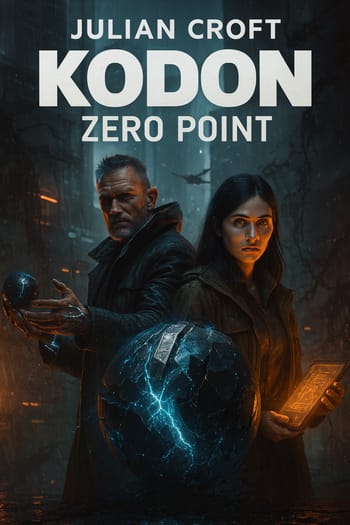
The cold, brilliant light of the core chamber was the color of a star seen through a vacuum. It was the light of pure, unedited causality, and it cast no shadows. Zane Kosta stood before the Aletheia Kernel, a black silhouette against its silent, crystalline heart. The engine was a massive, multi-faceted structure of dark, inert alloy, suspended in a web of cryogenic conduits that wept vapor into the sterile air. Kosta’s cybernetic hands, crafted from the same matte black material as his coat, moved with unnerving grace over the primary console. He was not hacking a system. He was conducting a sacrament. With a final, delicate touch, he began the Kernel’s activation sequence.
A low hum resonated through the chamber, a sound that was felt in the bones more than heard. The light from the Kernel’s core intensified, shifting from a neutral white to a colder, more analytical blue. The endgame had begun.
Sineus emerged from the corridor, a broken shape detaching itself from the hard-edged geometry of the doorway. He did not announce his presence. He simply moved, placing his damaged body between Kosta and the console. His left arm was a dead weight, strapped to his chest. His right hand held a carbon-steel combat knife, its edge a thin line of darkness against the chamber’s impossible light.
His internal systems overlaid his vision with a single, cold directive. Objective: Delay. It was not a hope or a prayer. It was a parameter. He was a tool, and this was his function. He had to buy time, measured in seconds and paid for in blood and broken bone, for the global network of ghosts and fugitives he had assembled.
— You are compromised, — Kosta’s voice was not a product of lungs and vocal cords. It was a synthesized signal, transmitted directly into Sineus’s mind, inflectionless and clean. — Your operational capacity is at 20%. Your presence here is illogical.
Sineus did not reply. Logic was a luxury for systems that were not terminally broken. He shifted his weight, the knife held low.
Kosta moved. It was not a charge; it was a recalibration of position, faster than a human eye could comfortably track. He closed the ten-meter distance in a blur of black fabric. His alloy hand sliced through the air, aimed not at Sineus’s throat, but at the wrist of his knife hand. It was a disarming strike, efficient and absolute.
Sineus’s Ghost-Sight flared, his unique ability to perceive memetic residue showing him the ghost of Kosta’s attack pattern a microsecond before it happened. He saw the memory of the motion, the training protocol burned into Kosta’s programming. It was not enough to counter, but it was enough to deflect. He twisted his body, letting the blow glance off his forearm. The impact sent a shockwave of agony up to his shoulder, but he held the knife. Steel rang against alloy.
— Your ghosts cannot help you, — Kosta’s synthesized voice stated, a simple declaration of fact. — They are echoes of a reality that has already been corrected. Erasure is purification.
Kosta attacked again, a fluid, three-strike combination. A kick to Sineus’s knee, a palm-heel strike to his chest, a final, precise chop at his neck. Sineus parried the kick, the impact jarring his entire frame. He took the palm-heel strike, the force of it driving the air from his lungs and sending him stumbling back. He ducked under the final blow, the edge of Kosta’s hand passing a centimeter from his carotid artery. The wind of its passage was cold.
He was outmatched. Kosta was faster, stronger, and whole. Sineus was a damaged instrument, running on final reserves. But his objective was not victory. He lunged forward, not at Kosta, but past him, towards the console. A desperate, suicidal gambit to interrupt the sequence.
Kosta intercepted him with contemptuous ease, his arm barring Sineus’s path like a steel girder. He drove Sineus back, the force of the collision throwing him against the base of the Kernel itself. The alloy was colder than ice, the hum of the engine vibrating through his back, a deep, resonant thrum of power waiting to be unleashed. The light from the core pulsed, and for a moment, Sineus’s vision glitched. The intense light cast a flickering, grey after-image of Kosta, a Palimpsest Phantom of the present moment, a pre-echo of a potential erasure.
— You seek to preserve the flawed script, — Kosta said, his obsidian lenses betraying no emotion. — You cling to the errors, the sentimental attachments, the pain. You call it truth. I call it noise.
Sineus pushed himself off the Kernel’s base, his breath a ragged plume of vapor in the cryogenic air. He tasted blood in his mouth. His internal display flickered, a small, unobtrusive timer in the corner of his vision counting down. Time to spike: 45 seconds.
He had to hold. He had to endure. He feinted with the knife, a low, sweeping arc aimed at Kosta’s legs. Kosta sidestepped it effortlessly and countered with a kick that shattered the composite plating on Sineus’s right shin. The pain was a clean, white spike. He partitioned it, shunting it away, but the damage was logged. His mobility was now compromised.
— Your struggle is a function of your flawed design, — Kosta’s voice echoed in his skull. — You are a relic, Sineus. Your lineage, your memories, your very concept of self—they are anchors to a corrupt past. The future must be a clean slate.
Sineus didn’t answer. He moved, his steps now uneven, circling Kosta. He needed to see the timer again, needed to confirm the window. He made a choice. He exposed his left side, the side with the broken arm, for a fraction of a second. It was an invitation. Kosta, ever the pragmatist, accepted it. His foot connected with Sineus’s ribs with the sound of cracking ice.
The agony was absolute, but it bought him the half-second he needed. As he fell, he saw the number. Time to spike: 30 seconds. He paid for the information in fractured ribs. The cost was acceptable.
He hit the floor hard, the impact jarring his teeth. He rolled, coming up on one knee, his knife held defensively. The chamber’s light seemed to dim, the hum of the Kernel deepening as the activation sequence neared its conclusion. The air grew colder, the promise of Oblivion a tangible presence. It was the feeling of a lie solidifying into reality.
Kosta stood over him, a perfect engine of destruction. He did not gloat. He simply waited, ready to deliver the final, efficient blow.
— It is over, — Kosta stated.
But it wasn’t. Sineus looked past Kosta, at the brilliant, terrible light of the Aletheia Kernel. His Ghost-Sight, pushed to its absolute limit by the pain and the proximity to the engine, flared. The phantom after-images that had flickered at the edge of his vision began to coalesce. They became clearer, more defined, as if the approaching wave of absolute truth from his allies was giving them substance. He saw the ghost of Elina Petrova, her face a mask of grim determination, standing beside the console. He saw the ghost of Volkov, a solid, unmoving presence at his back. They were not real. They were echoes, scars. But they were his.