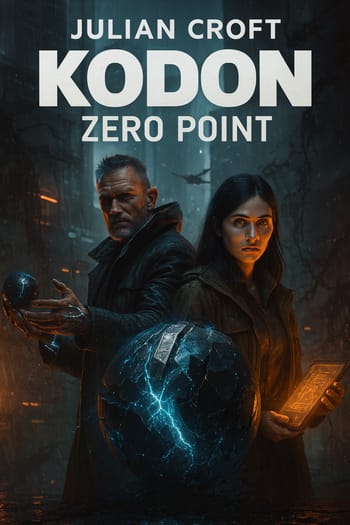
The quartermaster was a function, not a person. He stood behind a ferroconcrete counter in a grey, sterile room, the air smelling of ozone and weapon-cleaning solvent. The man’s face was a blank slate, his movements economical as he slid a dark, polished sphere across the counter. The object was heavy in Sineus’s hand, its obsidian surface unnaturally cold, absorbing the room’s flat, shadowless light.
— Kausal Compass, Model 7, — the quartermaster stated, his voice devoid of inflection. It was a piece of pre-war hardware, a navigational device keyed to the Chronos Shard’s signal. — Calibrated to the vector’s last known signature. It will not deviate.
Sineus gave a curt nod of acknowledgement. The man’s certainty was a product of RosNova’s doctrine: a belief in the infallibility of their instruments. It was a faith Sineus did not share. He secured the sphere in a pouch on his tactical belt and turned, his boots making no sound on the grated floor as he moved toward the transit hub. The lie of the instrument’s perfection was a comfortable one, but comfort was a liability.
He stepped onto the freight platform, a massive grid of rusted steel suspended over a chasm that plunged three kilometers into the heart of Vertikalgrad. The platform shuddered, then began its slow descent. The clean, pressurized air of the upper levels gave way to a thick, wet atmosphere that tasted of metal and decay. The price of this mission was the known world; he was leaving the curated reality of the Spire, a place of predictable systems and controlled variables, for the raw, chaotic truth of the depths.
The sterile white light of RosNova Command vanished above, swallowed by layers of smog and infrastructure. Below, the Undercity opened up, a tangled web of neon and shadow. Holographic advertisements for synth-sake and memory-wipes flickered against perpetually rain-slicked walls, their colors bleeding into the waterfalls of data-runoff that cascaded down the arcology’s superstructure. The controlled lie of the Spire was gone, replaced by the screaming, contradictory truths of a million lives fighting for purchase in the dark.
Halfway down, with the roar of the Undercity rising to meet him, Sineus retrieved the Kausal Compass. He held the obsidian sphere in his palm and activated it. A single, solid needle of holographic light materialized in its center, a brilliant white line of absolute purity. It pulsed with a slow, steady rhythm, pointing toward a specific heading deep within the transit warrens below. For a single moment, the path was clear. The truth was a straight line.
Then the memetic war arrived.
The needle shuddered violently. The single, perfect line of light fractured, splintering into a dozen wavering, probabilistic branches. Each one pulsed at a different frequency, a cacophony of false vectors generated by the rival factions. The Archive State was burying the path in narrative noise; Shenzhen Ascendant was attempting a brute-force redirect. The compass was now a useless explosion of contradictory information. The price of clarity had been paid by his enemies, and he was left with only the bill.
Sineus felt no frustration, only the cold, familiar logic of a system under attack. The tool was compromised. He needed a different way to read the signal. He closed his eyes for a second, then opened them. The world shifted.
His Ghost-Sight engaged, overlaying the physical world with the faint, grey glow of memetic residue. The Undercity became a storm of data-ghosts. He saw the flickering, silent forms of Palimpsest Phantoms everywhere: a worker endlessly falling from a high gantry, a vendor offering a product that no longer existed, a child reaching for a parent who was only a glitch in the rain. They were the scars of erased history, the background noise of a world constantly un-writing itself.
He held the fractured compass, letting his gaze drift past the chaotic light show within. He looked at the phantoms themselves. They were random, disconnected, each trapped in its own broken loop of forgotten purpose. But as he watched, he saw it. A pattern. A subtle, almost imperceptible alignment.
The phantom of the falling worker was oriented along one of the dozen vectors. The vendor’s outstretched hand pointed along the same path. The child’s desperate reach, a hundred meters away on a different platform, also followed that exact heading. They were unrelated ghosts from different times, their memories erased for different reasons, but the causal pointer of the Chronos Shard was so fundamental it was subtly warping the very fabric of their broken code, pulling them into alignment like iron filings to a magnet.
The phantoms were the filter. The scars of old lies were pointing the way to the new truth.
His cognitive load spiked as he processed the data, his mind cross-referencing dozens of phantom signatures against the splintered vectors in the compass. The true path burned itself into his vision, a line of probability so strong it felt solid. The other eleven vectors were just noise, memetic chaff designed to distract and delay.
He had his heading. The chase was on.
Sineus stepped off the freight platform as it docked with a lower transit station. The air was thick with the smell of fried circuitry and damp crowds. He ignored the press of bodies, his focus locked on the true vector only he could see. He moved deeper into the labyrinthine transit system of the Undercity, a ghost hunting a truth guided by other ghosts.
The compass in his hand still showed a dozen fractured paths. It was a broken tool. But for him, it was now perfectly clear.