Edict
Imagine a perfect world, meticulously crafted for the year 2050. Here, global corporations maintain a smiling peace by editing not just the news, but memory itself. The past is a malleable script, and any inconvenient truths are simply cut away, deleted from the collective consciousness. Citizens live in sterile, algorithmically managed cities, their emotions regulated and their life’s purpose assigned by an AI to ensure perfect, frictionless harmony.
But this sanitized existence comes at a cost. Every erased memory feeds an encroaching emptiness, a void that causes reality itself to glitch and decay. A flawless chrome monument might suddenly show the ghostly image of an erased protest in its reflection—a "reality fray" that vanishes an instant later.
While most are pacified by a single, ubiquitous media broadcast that papers over these cracks, a young director—once a master of propaganda—awakens to a terrifying ability: he can see the seams of this altered world. He is a virus in the system, an insider who discovers the most valuable currency is not money, but a single, authentic memory of a forgotten event. He must now fight to stop the discarded past from consuming existence, forcing a society addicted to comfort to choose between a beautiful lie and the chaotic, painful truth.
Latest book
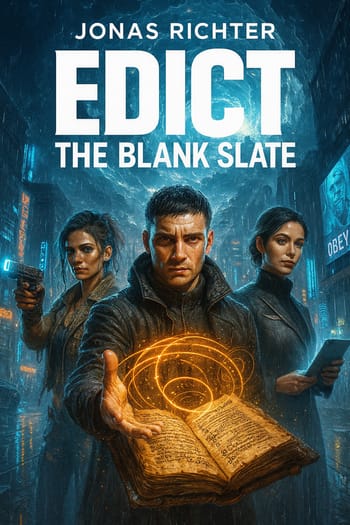
Imagine a perfect world, meticulously crafted for the year 2050. Here, global corporations maintain a smiling peace by editing not just the news, but memory itself. The past is a malleable script, and any inconvenient truths are simply cut away, deleted from the collective consciousness. Citizens live in sterile, algorithmically managed cities, their emotions regulated and their life’s purpose assigned by an AI to ensure perfect, frictionless harmony.
But this sanitized existence comes at a cost. Every erased memory feeds an encroaching emptiness, a void that causes reality itself to glitch and decay. A flawless chrome monument might suddenly show the ghostly image of an erased protest in its reflection—a "reality fray" that vanishes an instant later.
While most are pacified by a single, ubiquitous media broadcast that papers over these cracks, a young director—once a master of propaganda—awakens to a terrifying ability: he can see the seams of this altered world. He is a virus in the system, an insider who discovers the most valuable currency is not money, but a single, authentic memory of a forgotten event. He must now fight to stop the discarded past from consuming existence, forcing a society addicted to comfort to choose between a beautiful lie and the chaotic, painful truth.